

Three routines are underway before sunrise across rural sub-Saharan Africa.
A child walks a kilometre to a distant water source before school.
A woman queues at the community's single working tap while men leave for paid work.
An adolescent girl stays home because her school has no way for her to manage her period with dignity.
All three share one upstream cause: the community's water service does not work well enough for its women, girls and children to spend their time on anything else.
Water is not a gender-neutral utility. It is core infrastructure for women's time, safety, education and economic participation.
Boys walk that route too, but the disproportion is stark. WHO and UNICEF data records that women and girls aged 15 and over are the primary water collectors in 7 out of 10 households where someone has to fetch, against 3 out of 10 for men and boys.[1]
A water charity, writing about gender
FairAction is a research-led water charity advancing SDG Target 6.1, universal and equitable access to safe and affordable drinking water for all. Over more than nine years we have mapped 1,700 rural and peri-urban communities in Nigeria, catalogued 265 sustainability challenges, and validated a predictive sustainability model through live longitudinal field deployments.[2][3] The mission is global. Nigeria is the validation context; the Model is designed to be adapted to the other geographies where SDG 6.1 is hardest to deliver, and where gender equality is off track for the same reasons.
The daily choices women in these communities make, which water source to use, how far to walk, how many hours to give to unpaid collection, shape everything that follows for them and their daughters. This article sets out the evidence, walks the SDG 5 target framework, and closes with the operational answer.

Where gender equality and water sit today
Progress since 2015 is real and unevenly distributed. Global safely managed drinking water coverage rose from 68 to 74 per cent, driven almost entirely by rural gains, from 50 to 60 per cent, while urban coverage held steady at 83 per cent. Some 2.1 billion people still lack safely managed drinking water, concentrated in rural, low-income and fragile settings.[1] That is precisely the geography where the gender burden falls.
The country-level evidence sharpens the pattern.
Water across the SDG 5 targets
SDG 5 contains nine targets. Water threads through more of them than gender-sector reporting acknowledges. Five carry water directly; the others are affected indirectly through the same mechanisms. The five that carry water directly are set out below.
and domestic work
The infrastructure the target commits to providing
The target commits governments to recognising and reducing unpaid care work through public services and infrastructure. Where SDG 5 is most off track, water collection is not a marginal part of that care work. Every hour walking to a distant source is an hour not spent in paid work, learning or rest. UN Women documents that where time-saving infrastructure reaches these communities, the hours saved translate into gains in economic activity, learning and household health.[5] Reliable water service is not adjacent to SDG 5.4. It is the primary infrastructure the target names.
and menstrual health
Menstrual dignity depends on water that runs
Menstrual health now sits within the sexual and reproductive health frame. The 2024 JMP report on WASH in schools found only 39 per cent of schools globally provide menstrual health education, and fewer than one in three has bins for menstrual waste in girls' toilets.[7] The 2025 JMP household report added that adolescent girls aged 15 to 19 are less likely than adult women to take part in school, work or social activities during menstruation.[1] The gap concentrates in rural adolescents.[8] In Nigeria, only 16 per cent of schools have basic WASH services, weakest in rural areas.[6]
women and girls
The distance walked is the exposure
A 2023 systematic review in WIREs Water identified 18 peer-reviewed studies establishing an association between water insecurity and gender-based violence, concentrated in sub-Saharan Africa and South Asia, with long walks to water the dominant risk factor.[9] A 2024 study in peri-urban Kinshasa documented adolescent girls fetching water reporting physical, sexual and psychological violence at rates that carried through into school absence.[10] The evidence is cross-sectional rather than causal, but the direction is consistent and the mechanism is direct: reducing the distance women and girls walk reduces the exposure that walking entails.
leadership
Primary users, least represented
Women are the primary water users and the least represented in water-management decisions at every scale. A 2018 to 2019 World Bank survey of utilities across 28 countries found just 18 per cent of workers were women, and 12 per cent of utilities had no female managers at all.[18] A survey of 173 water organisations across the Global South found women held 26 per cent of leadership positions, and around 14 per cent of countries still lack mechanisms to ensure women's equal participation in water governance. A 2024 review of Nepal's water policies found the same: primary users, largely absent from formal decisions.[19] Nigeria's WASH gender assessment records women disadvantaged across every aspect of WASH despite a policy architecture that formally commits to equality.[6]
property rights
Time is an economic resource
Where women lose several hours a day to collection, they are structurally excluded from the market participation and enterprise that SDG 5.a commits them to. Rwanda has written unpaid care work into marital property law, valuing it at 10 to 39 per cent of jointly acquired assets, a reform driven by UN Women's finding that Rwandan women spend 3.7 hours a day on unpaid care.[5] The economic rights the target names are not deliverable without the time that water service returns to women.
The remaining targets, on discrimination, harmful practices, technology and legal frameworks, interact with water indirectly through the same mechanisms. Child marriage rates are highest where water insecurity concentrates, and time freed from collection has been associated with adolescent girls remaining in school and delaying marriage.
What the sector does well
The past decade delivered substantive progress. The JMP's 2024 introduction of menstrual health indicators gave the sector its first comparable data picture across 70 countries.[7] UN Women and its partners drove care-economy reforms in several African countries, moving unpaid care work from marginal to mainstream in policy discussion. Nigeria's National Gender Policy for 2021 to 2026 and its Water Resources Gender Mainstreaming Policy of 2022 name WASH and gender equality explicitly.[6] The framework exists. What is missing is the operational reality it commits to.
What the sector has not yet solved
Progress has not reached the geographies that need it most. The gender and water sectors do not aggregate the outcomes they share. Gender-sector reporting does not routinely count water service as an intervention, and water-sector reporting does not routinely count gender outcomes as success metrics. The measures that would show whether SDG 5 is being delivered through SDG 6.1 investment, women's time recovered, girls' school retention through adolescence, adolescent-girl safety on water routes, women's inclusion in community water governance, are not tracked routinely in either sector's monitoring architecture.
A borehole that fails in the dry season frees no one's time. Sustainability is not a technical footnote to gender-equality outcomes. It is the condition on which they depend.
Every mechanism this article has established depends on water service that works when women and girls need it. A school WASH facility that has water three days a week does not protect menstrual dignity. Enrolment metrics record a village as served if a borehole was built in it; the women there know it broke in year two. Both are true, and the women's knowledge is what determines whether SDG 5 outcomes actually arrive.
Hope and Ballon, writing in 2019, summarised the operational reality: when a rural waterpoint fails in Africa, it takes a month or more to repair.[11] A month-long failure in the wet season is inconvenient. In the dry season, in a community without alternatives, it unwinds every gain the initial investment was meant to deliver. In urban areas the alternative to a failed source is vended or municipal water; in the communities where SDG 5 is most off track, it is the walk back to the contaminated stream.
Three FairAction positions
The following are three positions FairAction holds. Each is contested within the sector, and we set them out because we think the contest matters.
Water service quality, not access, is the binding constraint
Both the gender and WASH sectors treat access as the leading indicator: women reached, water points built, coverage percentages. For SDG 5 outcomes, access without reliable service is a misleading metric. A woman whose community has a handpump that works two-thirds of the year is not freed from the water burden during the third when it does not. The unit of measurement should be service-days delivered with continuous, microbiologically safe water at usable proximity, not households counted at build.
Water investment should count as gender-equality programming
The current funding architecture treats WASH and gender equality as adjacent, and neither budget owns the joined-up outcome. Where SDG 5 is most off track, the highest-return gender-equality intervention is sustained water service. That implies counting WASH investment in the gender-equality envelope where it demonstrably serves gender outcomes, and reporting the outcomes that matter to women, time recovered, girls' school retention, menstrual dignity, alongside what both sectors report separately.
Metrics should follow service, not construction
In FairAction's mapping of 1,700 communities in Nigeria, close to half of the communities with existing water infrastructure had a failed system at the time of survey.[3] A borehole counted at build is not a gender outcome. A borehole delivering service five years later is. Neither the gender nor the WASH sector currently tracks the distinction, and both should.
What FairAction does about it
Durable rural water service is what changes the daily lives of the women in a community. The FairAction Model is built to deliver that service, and integrates three functions as a single connected practice.
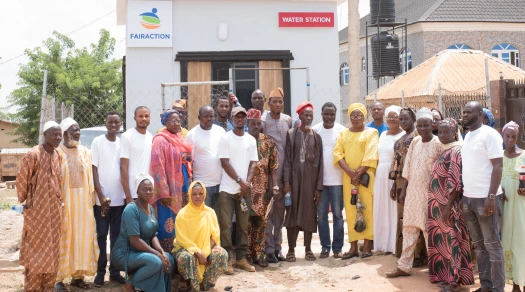
Listening to the mothers first
Each community is understood on its own terms before any solution is committed, grounded in a systematic review of the literature and the mapping of more than 1,700 communities, from which 265 sustainability challenges have been catalogued across 52 themes and six root causes.[2] A structural element of the pre-construction phase is a household survey, and in each household the primary respondent is the mother, because mothers are the primary household water managers in the geographies FairAction operates in.

A role held by a woman
Each infrastructure carries years of preparatory research before the build and live longitudinal monitoring after. The longest-running site has produced more than four and a half years of continuous performance data, at 100 per cent sustainability and 98.7 per cent reliability. Kiosk attendants are full-time salaried employees, and the role is designed to be held by a woman, with locally-driven exceptions where a female representative is not available. The attendant is the daily point of contact between the community and the operational team.

Every community makes the next one better
What the mothers in one community told the pre-construction survey shapes how the Model listens in the communities that follow. The learning is held inside the Model and used to expand the work in Nigeria, then shared and adapted to new regions through frameworks, tools and partnerships. The underlying research is published across peer-reviewed international water journals[2][3][12] and developed through an Industry Doctorate Programme with the University of Technology Sydney.
This is the architecture by which FairAction translates the argument into a working system: a Model that learns from the mothers who will use each infrastructure before it is built, sustains it in the years after, and catches failures before the daily reality slides back.[13]
What this means for SDG 5, and its funders
The SDG 5 agenda will not be delivered where it is most off track without reliable water service becoming a routine part of gender-equality programming. Continuing to fund the gender agenda and the water agenda in separate silos leaves the joined-up outcome nobody's responsibility, and it is that outcome on which women's daily lives depend.
- Fund service, not construction. The highest-return marginal contribution to SDG 5 outcomes in the geographies where it matters most is not another standalone advocacy grant. It is sustained water service that frees women's time, protects adolescent girls' safety and school retention, and shifts the conditions that many other gender interventions rely on.
- Count and report the outcomes that matter to women. Time recovered, girls' school retention through adolescence and menstrual management dignity belong in the reporting, alongside the access and coverage figures both sectors already publish.
- Back a Model designed to last. FairAction's research base is documented across peer-reviewed publications in Water Policy and Water Supply, and its operational evidence is accumulating in real time across live longitudinal field deployments.
If you fund gender equality, this is a case for where part of the money goes. That is what the FairAction Model is built to deliver. We invite donors, foundations and institutional funders working in gender equality, or in joint gender-WASH portfolios, to engage with us directly on how a sustainable service approach can be embedded in the programmes you support.[13]
References
- 1WHO and UNICEF Joint Monitoring Programme (2025). Progress on Household Drinking Water and Sanitation 2000-2024: Special Focus on Inequalities. WHO press release, 26 August 2025. who.int
- 2Adeoti, O. S., Kandasamy, J., Vigneswaran, S. (2023). Water infrastructure sustainability in Nigeria: a systematic review of challenges and sustainable solutions. Water Policy 25(11):1094-1111. doi.org/10.2166/wp.2023.173
- 3Adeoti, O. S., Kandasamy, J., Vigneswaran, S. (2024). Water infrastructure sustainability challenge in Nigeria: a detailed examination of infrastructure failures and potential solutions. Water Supply 24(6):2066-2076. doi.org/10.2166/ws.2024.127
- 4UNICEF (2016). Collecting water is often a colossal waste of time for women and girls. unicef.org
- 5UN Women. Transforming care systems in West and Central Africa. UN Women Africa. africa.unwomen.org
- 6UNICEF Nigeria (2026). From Gender Sensitivity to Transformation: Nigeria's WASH GALA Findings. unicef.org
- 7WHO and UNICEF Joint Monitoring Programme (2024). Progress on Drinking Water, Sanitation and Hygiene in Schools 2015-2023: Special Focus on Menstrual Health. washdata.org
- 8Tshivule, M. Z., Rasweswe, M. M., Mothiba, T. M., Bopape, M. A. (2025). Factors influencing menstrual hygiene knowledge, attitudes and practices among adolescent girls in African rural schools: scoping review. Frontiers in Reproductive Health. frontiersin.org
- 9Tallman, P. S., Collins, S., Salmon-Mulanovich, G., Rusyidi, B., Kothadia, A., Cole, S. (2023). Water insecurity and gender-based violence: a global review of the evidence. WIREs Water 10(1):e1619. wires.onlinelibrary.wiley.com
- 10Nlunda, J.-M. M., Geere, J.-A., Sangana, C. B., Konde, J. N. K., Kiyombo, G. M. (2024). Prevalence and patterns of gender-based violence among adolescent girls fetching water in peri-urban settings of Kinshasa, DR Congo. Journal of Water, Sanitation and Hygiene for Development 14(8):603-615. iwaponline.com
- 11Hope, R., Ballon, P. (2019). Global water policy and local payment choices in rural Africa. npj Clean Water 2:21. nature.com
- 12Adeoti, O. S., Kandasamy, J., Vigneswaran, S. (2024). Sustainability framework for water infrastructure development in Nigeria: a modeling approach. Water Supply 24(8):2933-2945. doi.org/10.2166/ws.2024.193
- 13FairAction International. How We Work. fairaction.ngo/about/how-we-work
- 14UN-Water (2026). UN World Water Development Report 2026: Water for All People, Equal Rights and Opportunities. unwater.org
- 15National Family Health Survey (NFHS-5), India. Rural household water collection responsibilities. downtoearth.org.in
- 16UNICEF Bangladesh. Water, Sanitation and Hygiene. unicef.org
- 17Carr, R., Kotz, M., Pichler, P.-P., Weisz, H., Belmin, C., Wenz, L. (2024). Climate change to exacerbate the burden of water collection on women's welfare globally. Nature Climate Change 14:700-706. doi.org/10.1038/s41558-024-02037-8
- 18World Bank (2019). Women in Water Utilities: Breaking Barriers. Water Global Practice. unwater.org
- 19Joshi, S., Ghimire, R. (2024). Women in water resource management: a review of water policies of Nepal. World Water Policy 10(2):566-582. onlinelibrary.wiley.com