

Our History

The same stream. The same village. The story behind FairAction.

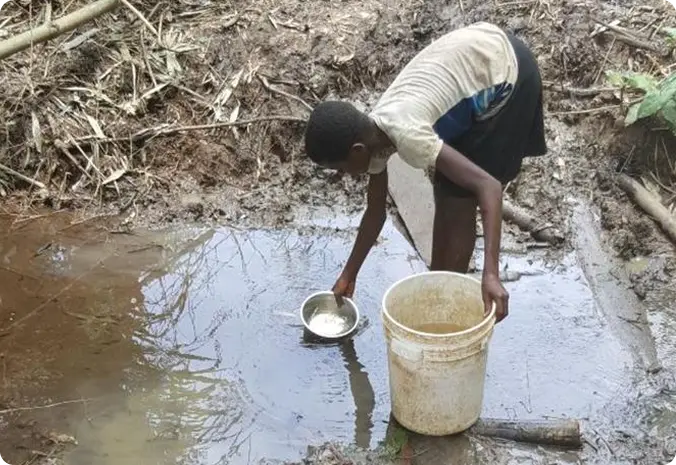
The child in this photograph is collecting drinking water from a contaminated stream in Ijero-Ekiti, Nigeria. It is the same village, and the same kind of stream, that our founder Samuel Adeoti walked to as a child. It is the daily reality for tens of millions across Nigeria and sub-Saharan Africa, and the reality FairAction was founded to change.

Ijero-Ekiti, Nigeria 7.79037° N, 4.99954° E

View on Target 6.1 Map
A person collects water from a muddy puddle using a bowl, pouring it into a white bucket, in a rural, undeveloped area.
Founder

Samuel Adeoti

Founded

2016, Australia

Mission

Clean water for all

Years of impact

Nine & counting

Headquarters

Sydney, NSW

01 · The founder

Meet our founder.

Samuel Adeoti Founder & CEO · Fairaction International
Samuel AdeotiFounder & CEO · Fairaction International

Samuel was born into comfort. When he was ten, his family lost everything and moved to Ijero-Ekiti, a village without reliable clean water. Overnight, the boy who had taken safe water for granted was walking four kilometres a day to a dirty stream, falling ill from what he drank, and missing school.

The walks took him past something else: donor-funded boreholes that had been celebrated when they were built, and abandoned soon after. Failed pumps. Broken taps. Communities that had been "given water" on paper and were still walking for it in practice. Even as a child, Samuel could see the problem wasn't only the absence of water projects. It was the absence of water projects that lasted.

Those two experiences shaped everything that came next. The first told him why the work mattered. The second told him how it had to be done.

Samuel went on to earn a Bachelor of Science (Honours) in Mathematics and Industrial Mathematics, a master’s in Mathematical and Statistical Modelling, and a PhD in Civil and Environmental Engineering from the University of Technology Sydney. His doctoral research was devoted to understanding why water solutions fail, and what makes them last. Today FairAction is an industry partner of UTS, whose water resources program is ranked #11 in the world and #1 in Australia and New Zealand by U.S. News & World Report’s Best Global Universities 2026-27. FairAction is the practical answer to the question Ijero-Ekiti put in front of him.

02 · The vision

Hope in every drop: a vision for sustainable water access.

The mission was clear from the start, and has not changed since: universal and equitable access to safe and affordable drinking water for all by 2030, the UN's Sustainable Development Goal 6.1. The approach was what set FairAction apart. Installing water infrastructure without a plan for sustainability is not a solution; it is a project that will fail and leave the community further behind. That conviction is the thread running through the nine-year journey that follows.
Our journey

Nine years of research and impact.

Communities served. Evidence published. A model the sector can adopt. Every step toward Clean Water for All by 2030, in support of UN Sustainable Development Goal 6.1.

Founding · ACNC registration

FairAction International is registered as an Australian charity.

FairAction International is registered with the Australian Charities and Not-for-profits Commission as a water charity, established as a Public Benevolent Institution with the charitable purpose of advancing public welfare, and later endorsed as a Deductible Gift Recipient.

First operations on the ground

Establishing where we work, and how we work.

From 2017, FairAction is operating on the ground in Nigeria, working directly with local partners. Nigeria is where the work begins. As the most populous country in Africa, with one of the most severe and operationally complex water poverty contexts in the world, it offers a strong test environment for a sustainable model. A solution that holds here forms a foundation that can be adapted to other regions globally.

First campaign · First partners

Sustainable water needs sustainable backing.

FairAction's first organisational push is to align the funding side of the mission with the cause itself. In partnership with Essential Need Projects, an Australian NGO with a Clean Water for All mission, FairAction launches the Conscious Business Campaign in New South Wales: an advocacy initiative educating Australian businesses on the global water crisis and inviting them into structured partnerships in support of UN SDG 6.1. The network grows to include over 2,000 Australian businesses.

Initial diagnostic · 204 communities

Initial diagnostic: understanding the problem at its root.

FairAction conducts its first diagnostic study in Nigeria: a community mapping pilot covering 204 communities. Each is assessed for water access, infrastructural condition, and functional reliability. The pilot establishes the data instrument that all later field research will be built on, and produces the first hard evidence that the question for the sector is not whether infrastructure exists, but whether it lasts.

The repair years

We tried fixing what was already broken.

The pilot mapping had made one fact unavoidable: most water infrastructure was already there, just non-functional. FairAction begins repairing donor-built boreholes flagged by the data. Pumps come back online. Communities celebrate. Within months, the same systems break again. The pattern is clear, and it is the same one that has failed the sector for decades. Fixing what was never built to be sustainable will always fail again.

Expanded mapping · Target 6.1 Map concept

From 204 communities to 1,700+.

FairAction expands the diagnostic across three Nigerian states, surveying 1,700+ communities with GPS, household interviews, and a deeper instrument. The findings are unsparing: 49.8% have no improved water source, and half of those that do are dealing with broken systems. Community ownership correlates strongly with functionality. Toward the end of 2020, FairAction begins designing an algorithmic system with Essential Need Projects: a sector-wide planning tool that would later become the Target 6.1 Map. The same year, the realisation lands. FairAction stops repairing. It starts designing infrastructure to last from day one.

FairAction Nigeria registered

A local entity, for accountable local delivery.

After four years of working through local partners, FairAction registers FairAction Nigeria as a formal local entity headquartered in Nigeria. The decision is deliberate. To do this work properly, governance, employment, community accountability, and infrastructure ownership all have to sit on the ground in Nigeria, not in Sydney. FairAction Nigeria is the team that will conduct the field research, employ kiosk attendants from each community, build the infrastructure, and stay with every project long after construction is complete.

First Smart Water Kiosk · SWI1-NG-OY-1353

Abeku Smart Water Kiosk. 21 May 2021.

FairAction commissions its first Smart Water Kiosk in Abeku, Nigeria, serving roughly 1,000 people. Solar-powered, IoT-monitored, and operated by a community-nominated kiosk attendant employed full time, with the water source independently safety-tested against the Nigerian national drinking water standard. Water is sold at a community-set price that funds ongoing maintenance, so the system pays for its own operation rather than waiting for the next round of donor funding. Abeku is also the first installation that becomes a long-term research site, with operational data collected continuously from launch and analysed in the work that follows.

UTS Industry Doctorate Programme

Research capacity gains institutional backing.

FairAction enters an Industry Doctorate Programme with the University of Technology Sydney (UTS), formalising its work as a live applied-research programme. The arrangement places FairAction's field research under peer review, embeds it inside Australia's research infrastructure, and gives the model academic standing alongside its operational evidence.

Clean Water for All partnership

A partnership built for scale.

FairAction partners with Clean Water for All (CWFA), an organisation that shares FairAction's clean-water-for-all mission, with a complementary focus on building the algorithmic systems and AI tools the sector needs to scale sustainable water service. CWFA needs research-grounded data and live community evidence; FairAction needs the engineering capacity to turn its research into instruments the sector can actually deploy. The partnership formalises a mission-aligned exchange that empowers both organisations: FairAction conducts the field research, CWFA helps build the tools, and both advance the same outcome. Within the year, full development begins on the Target 6.1 Map, which will develop into an end-to-end system for water project management.

Sustainability Framework

Organising the scope of the challenge.

By 2023, FairAction had years of field evidence on water infrastructure sustainability challenges. The team brought that together with two decades of research from the wider water sector and worked through it systematically. The picture that emerged was clear: 265 sustainability challenges, falling into 52 themes and six root causes.
That picture laid the foundation on which the Sustainability Framework for Water Infrastructure is built. It is the first framework of its kind grounded in Nigerian field evidence and designed for the wider sector to use, and it is the standard every FairAction project is designed against.

PISM · Diagnostic instrument · Context-specific design

PISM. Every community gets a path forward.

FairAction's research team operationalises years of field evidence into the Predictive Iterative Sustainability Model (PISM): a diagnostic framework that asks not whether a community deserves a water project, but what each community needs to reach a sustainable one. PISM produces a Viability Rating that surfaces readiness, a Sustainability Rating that predicts long-term operation, and an iterative refinement loop that turns operational data into better future designs. For some communities, readiness means infrastructure goes in next. For others, readiness means education, governance, or capacity-building must come first. PISM tells the difference. From 2024 forward, every FairAction project is shaped by PISM, and the model is designed for sector adoption: a diagnostic logic any water-sector organisation, anywhere in the world, can apply to design the right solution for each community they serve.

Smart Mobile Water Kiosk · SWI2-NG-OY-1567

Isale-Oja. A new kiosk design, born from the data.

On 17 August 2024, FairAction commissions a Smart Water Kiosk of an entirely new kind in Isale-Oja, Nigeria: the Smart Mobile Water Kiosk, equipped with full water treatment infrastructure. The mobile design is a direct response to a finding from Abeku's three-year operational dataset: when an uncoordinated donor project lands inside a community already served by a sustainable kiosk, the existing system collapses through what FairAction's team would later name aid overlap. The mobile kiosk solves the problem structurally. It can be relocated when conditions change, when aid overlap occurs, or when a community's needs shift. Isale-Oja is also FairAction's first project commissioned alongside the Australian High Commission in Abuja, and it serves roughly 500 people while feeding live data back into the model.

Smart Water Kiosk · SWI3-NG-OY-1530

Alabata. Generations of waiting, ended.

On 12 October 2024, FairAction commissions a Smart Water Kiosk in Alabata, Nigeria, a community that had relied on unprotected wells and rainwater for generations. The kiosk, with full water treatment and IoT monitoring, serves roughly 500 people. PISM informs the design, and the Australian High Commission supports the build.

ACFID Member · Code of Conduct signatory

Sector accreditation, on the strength of the work.

On 19 December 2024, FairAction is admitted as a member of the Australian Council for International Development (ACFID), the peak body for Australian aid and development organisations. Membership signals that FairAction has met the standards of the ACFID Code of Conduct: governance, financial accountability, child safeguarding, complaints handling, and ethical fundraising. The Code is the Australian sector's benchmark for good practice, and FairAction signs it in full.

Two foundational findings · Two operational sites

Aid overlap, and the Underutilisation Principle.

Three years of operational data from Abeku, alongside research at Isale-Oja, surface two dynamics the water sector had observed but never formally documented.

The first is aid overlap: when an uncoordinated donor installs free-water infrastructure inside a community already served by a sustainable kiosk, the existing system collapses. Residents migrate, water sales evaporate, and a project on track to fund its own operation needs external support to survive. Documented for the first time in the academic literature, with direct implications for how donors and governments coordinate at scale.

The second is the Water Infrastructure Underutilisation Principle, drawn from Isale-Oja: even when safe, treated water is available, adoption is governed by proximity and perception, not access. The principle gives the sector a transferable framework for diagnosing underutilisation risk before construction.

Smart Water Kiosk · SWI4-NG-OY-1756

Aba Apapa. Building water people will actually use.

On 31 May 2025, FairAction commissions a Smart Water Kiosk in Aba Apapa, Nigeria, the first kiosk designed in direct response to the Underutilisation Principle findings from Isale-Oja. The Isale-Oja research had shown that a community may perceive its existing water source as safe, even when it is unhygienic and unsafe by health standards, and decline to switch when treated alternatives are available. Aba Apapa adds a new methodological step: community perception is now assessed as a diagnostic input before construction, alongside infrastructural and environmental conditions. PISM informs the design, the kiosk launches, and continues to serve its community.

Smart Mini Water Kiosk · SWI5-NG-OY-1760

Boni, Igboho. Over 200 years of waiting, ended.

On 31 July 2025, FairAction commissions the Smart Mini Water Kiosk in Boni, Igboho, a community that had waited over 200 years for safe water access. The Mini design is engineered specifically for extremely remote communities, where logistics, supply chain, and ongoing service maintenance pose distinct challenges that the standard model is not designed to address. With the launch, FairAction now operates three distinct kiosk types: standard, mobile, and mini, each engineered against a specific operational reality the research had surfaced.

Safe Water, Safe Lives · University of Ibadan

Education and advocacy, part of the work.

In August 2025, FairAction launches Safe Water, Safe Lives, a water education and advocacy campaign developed in collaboration with the University of Ibadan. The campaign advances SDG 6.1 by building community knowledge of water safety, hygiene, and the practices communities can adopt to protect their own access. Subsequent editions are planned in partnership with universities across Nigeria.

Water safety · SDG 6.1

Bringing safety into the model.

FairAction, with UTS and partners, closes a gap the sector had been delivering around: water access without water safety. The research establishes that Nigeria's public boreholes, including federal installations, cannot meet SDG 6.1 on the current handpump model. It delivers a field-testable proxy that reduces the cost of water safety monitoring in settings where conventional laboratory testing is impractical, and proves that affordable treatment, integrated into Smart Water Infrastructure, can deliver health-critical compliance at scale. The proxy is now being further developed for adoption in other contexts where the cost of monitoring has been a barrier, including remote Australian communities. With this work, water safety becomes a core component of FairAction's model for SDG 6.1, alongside the diagnostic mapping, the Sustainability Framework, and PISM.

Looking forward

Carrying the work forward, together.

There is much we want to do between now and 2030, in partnership with governments, donors, and others working to advance Clean Water for All. We will:

  • Continue to advance our research and publish our findings, keeping the evidence base open for the sector to build on.

  • Map every community across Nigeria, and any country where funders and donors are ready to invest.

  • Expand sustainable water solutions across communities in need.

  • Adapt the model to remote Australia, including First Nations communities.

  • Contribute our research findings, innovations, and digital tools to the sector: peer-reviewed publications, the Sustainability Framework, PISM, the Target 6.1 Map, and field-tested infrastructure designs ready for adoption.

  • Advocate for sustainability-first, and raise resources and support for sustainable solutions and approaches to advance SDG 6.1.

Or learn more about the FairAction Modelour team