
Where we work
Wherever water poverty persists.
FairAction works where communities still lack safe, reliable, affordable, and sustainable drinking water, and where the global water sector is still working to close the gap between water investment and lasting service.
Nigeria, our active pilot and proving ground
Regions where our work can be adopted and adapted
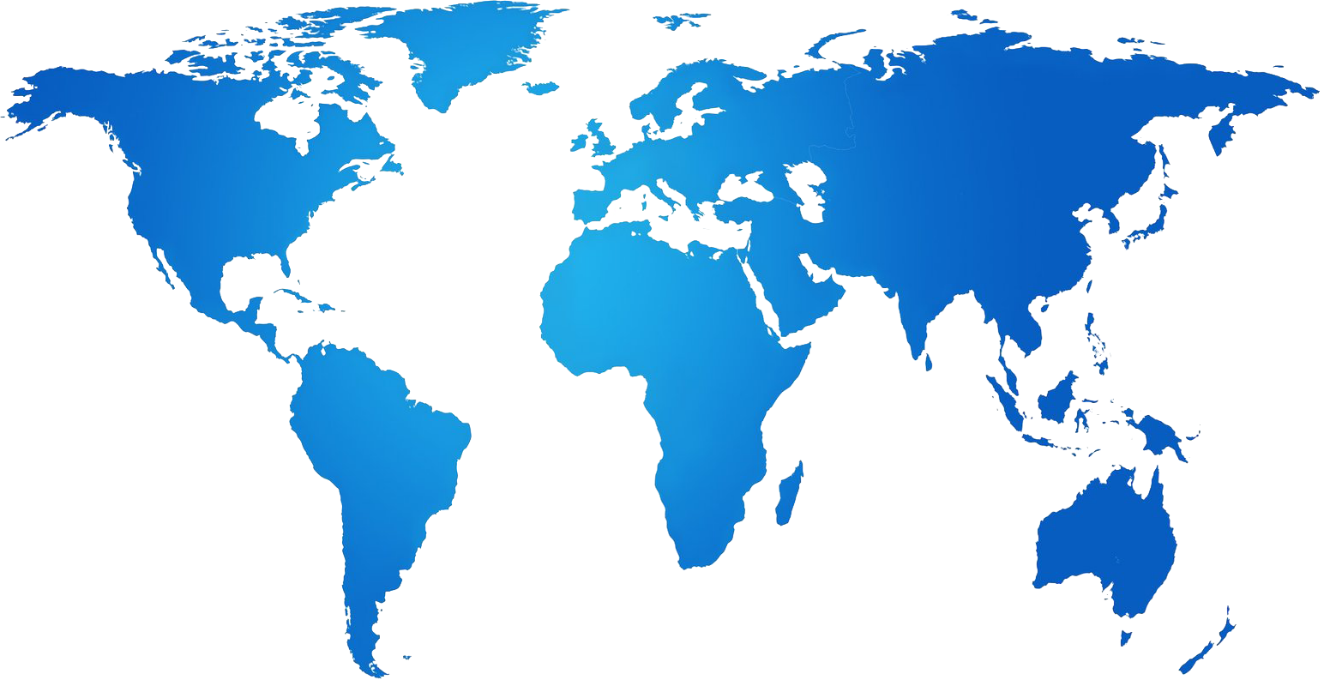
Global relevance
Where our work
can support change.
Globally, over 680 million people are in urgent need of basic drinking water access, and an additional 2 billion live without safely managed water at home (JMP, 2025). FairAction's work is designed to be adopted and adapted to support water actors and lead projects in the regions below.
01Nigeria, our proving groundActive pilot · 1 country
Active pilot · 1 country
Across boreholes FairAction has assessed in Nigeria, 88.2 per cent failed to meet the Nigeria Industrial Standard for Drinking Water (NIS 554:2015), and 58.8 per cent showed contamination from E. coli, iron, fluoride, manganese, or sulphate.[1]
Infrastructure has been built; the challenge is what happens after. FairAction's mapping work across 1,696 communities in Nigeria has documented the recurring patterns: premature failure, weak post-construction support, unsafe water from systems treated as "safe," and no live data on whether infrastructure is actually delivering service.[2]
Nigeria: active research, design, build, and live-monitoring pilot
Five operational Smart Water Kiosks (Abeku, Isale-Oja, Alabata, Aba Apapa, and Lub Booni) anchor the active pilot, capable of serving 5,000+ people. As at 2024, three years of operational data had informed the mobile kiosk design and the model's iteration, with continuous monitoring and improvement ongoing.[3] The full FairAction capability is engaged here through community mapping, IoT-based smart monitoring of flow and quality, water treatment integrated with infrastructure, sustainability assessment across six factors, community-led operating models, and applied research published in peer-reviewed sector journals.[4]
02Western Africa13 countries
13 countries
Sector studies have documented sustained service-delivery failure across Western Africa. A significant share of rural boreholes are non-functional at any given time, and water-point repair backlogs are particularly high in northern regions where service-delivery infrastructure is thinnest. Across the wider Sahel, climate stress and groundwater variability compound the post-construction sustainability problem FairAction has documented in Nigeria.[5]
Ghana · Sierra Leone · Liberia · Côte d'Ivoire · Benin · Togo · Burkina Faso · Mali · Niger · Senegal · Guinea · The Gambia · Guinea-Bissau
The patterns FairAction has mapped across 1,696 Nigerian communities and the operational evidence from five pilot kiosks transfer directly to this region's challenges. The model can be adopted and adapted by water actors here through community mapping, pilot-scale smart kiosks tested before scale, IoT-based flow and quality monitoring, treatment-integrated infrastructure, and operating models built for community-led continuity.
03Eastern Africa11 countries
11 countries
Rural water systems in this region face the same post-construction sustainability problem documented across Sub-Saharan Africa: roughly one in three handpumps is non-functional at any given time, and 30 to 40 per cent of rural water systems fail prematurely.[6] The gap between basic access and safely managed service is wide, and drought, conflict-affected operating environments, and weak monitoring capacity make service continuity hard to sustain. The shared challenge with Nigeria is what happens after infrastructure is built.
Sudan · South Sudan · Ethiopia · Eritrea · Somalia · Djibouti · Kenya · Uganda · Tanzania · Rwanda · Burundi
The FairAction Model is built on continuous post-construction monitoring of 16+ service metrics, exactly the gap the literature identifies as the missing piece in rural water sustainability. The model can be adopted and adapted by water actors here through smart monitoring, proxy monitoring where direct field access is difficult, sustainability assessment across our six-factor framework, and operating model co-design.
04Middle Africa7 countries
7 countries
In the DRC, tens of millions of people lack access to safe drinking water and rural service coverage is among the lowest globally. In Cameroon, sector studies estimate that around one in three handpumps is non-functional, and many lack access to any structured repair service.[7] Forest and basin geographies, dispersed rural communities, and post-conflict operating environments make service continuity difficult. The shared challenge with Nigeria is what happens after infrastructure is built, often in contexts where qualified technicians and spare parts are not within reach.
Chad · Democratic Republic of Congo · Central African Republic · Republic of Congo · Cameroon · Gabon · Equatorial Guinea
FairAction's mapping methodology and the Smart Water Kiosk model were developed for exactly this kind of post-construction sustainability gap. The model can be adopted and adapted by water actors here through community mapping, pilot kiosks designed for community-led operation, decentralised monitoring where central oversight is impractical, sustainability assessment across our six-factor framework, and operating models that account for technician access and spare parts continuity.
05Southern Africa11 countries
11 countries
Sector evidence across Southern Africa points to a recurring sustainability gap: handpumps that appear functional during a snapshot inspection often fail within a few years of installation, and water committees themselves report low confidence that systems will last. Water quality is a parallel concern, with significant proportions of rural household samples in countries like Mozambique testing at high-risk contamination levels.[8] The challenge here is the same one FairAction has documented in Nigeria: built infrastructure that does not deliver lasting safe service.
Angola · Zambia · Zimbabwe · Mozambique · Malawi · Madagascar · Namibia · Botswana · Lesotho · Eswatini · South Africa
FairAction's combined infrastructure-and-monitoring approach addresses functionality and water quality together, rather than as separate problems. The model can be adopted and adapted by water actors here through community mapping, pilot kiosks with treatment integrated, remote monitoring of flow and quality, sustainability assessment across our six-factor framework, and operating models that build long-term continuity into design.
06Central and Southern Asia6 countries
6 countries
India's Jal Jeevan Mission has lifted rural tap-water coverage from 17 per cent in 2019 to over 80 per cent, but the next phase of work is squarely about service quality: irregular supply, distribution leakages, recontamination across networks, and natural arsenic, fluoride, and iron contamination affecting habitations across West Bengal, Bihar, and beyond.[9] The same arsenic belt extends through Bangladesh and parts of Nepal. Across the wider region, around 600 million people live with high to extreme water stress.[10] Built infrastructure is increasing fast; the gap is whether it sustains and delivers safe water.
India · Pakistan · Bangladesh · Nepal · Sri Lanka · Afghanistan
FairAction's IoT-based smart monitoring approach was built for exactly this gap, where infrastructure exists but real-time water-quality and service-continuity data does not. The model can be adopted and adapted by water actors here through community-level mapping, pilot deployments of smart monitoring at the service point, water-quality testing integrated with infrastructure, treatment evaluation for arsenic and fluoride contexts, and sector research on what makes service last.
07South-Eastern Asia and Oceania8 countries
8 countries
Across the East Asia and Pacific region, more than 80 million people lack even basic drinking water service. Papua New Guinea is one of the lowest performers globally: only 41 per cent of the population has access to safe drinking water and just 21 per cent has safely managed service. PNG, Solomon Islands, and Fiji are among the countries going backwards on rural water access.[11] Decentralised geographies, dispersed island and forest communities, and limited subnational capacity make service continuity hard, and the gap between basic access and safely managed water remains wide.
Indonesia · Philippines · Papua New Guinea · Timor-Leste · Cambodia · Laos · Myanmar · Vietnam
FairAction's mobile Smart Water Kiosk design is built for relocation and adaptation, an approach well-suited to dispersed and seasonally-affected communities. The model can be adopted and adapted by water actors here through community mapping, pilot deployments tested before scale, decentralised monitoring built into infrastructure, treatment integrated with service delivery, and operating models built for community-led continuity.
08Latin America and the Caribbean11 countries
11 countries
In Latin America and the Caribbean, the gap between basic access and safely managed services is wide, with the worst access concentrated in rural areas. Haiti has among the lowest coverage in the region. Stark inequalities exist within countries, with rural households in low-income communities significantly less likely to have water access than wealthier urban households. Sector commentary from the World Bank and others has highlighted that across the region, investments tend to focus on building infrastructure and underestimate the need for continuous post-construction support,[12] the same pattern FairAction has documented in Nigeria.
Haiti · Guatemala · Honduras · Nicaragua · Belize · El Salvador · Bolivia · Peru · Paraguay · Guyana · Suriname
FairAction's research-led approach is built around continuous post-construction support, exactly the gap the regional data identifies. The model can be adopted and adapted by water actors here through community mapping, pilot deployments testing service models before scale, integrated water-quality monitoring, treatment evaluation, sustainability assessment across our six-factor framework, and applied research on what makes service last.
09Australia, New Zealand and Northern Americaincl. AU, CA
incl. AU, CA
In Australia, many remote First Nations communities lack access to regular water quality testing, exposing residents to contaminants such as arsenic, fluoride, uranium, and nitrate at levels that can exceed national guidelines.13 In Canada, long-term drinking water advisories remain in effect across multiple First Nations communities, with some advisories in place for over a decade.14 Distance, small population systems, and limited local capacity make it impractical to keep pace with the lab-based testing routine service operation requires. The challenge here is the same one Fairaction has documented in Nigeria, in a different operating context.
Including remote communities in Australia, Canada, and other high-income countries
Fairaction's research includes proxy water quality monitoring methods designed for places where conventional lab testing is not feasible. The model can be adopted and adapted by water actors here through proxy water quality monitoring as a priority, alongside remote monitoring of flow and service continuity, treatment evaluation, and operating models built for low-population-density service.
References14 sources
FairAction International (2024). Borehole water quality assessment in Nigeria. fairaction.ngo.
Adeoti, O.S. (2025). Smart solutions: a Nigerian answer to access. The Source, International Water Association. thesourcemagazine.org.
FairAction International. Smart Water Kiosk programme: operational data from Abeku, Isale-Oja, Alabata, Aba Apapa, Lub Booni (2021 to 2024). fairaction.ngo.
Adeoti, O.S., Kandasamy, J., & Vigneswaran, S. (2023). Water infrastructure sustainability in Nigeria: a systematic review of challenges and sustainable solutions. Water Policy, 25(11), 1094-1111. doi.org/10.2166/wp.2023.173.
Rural Water Supply Network handpump functionality data and sector reviews on rural water point functionality across sub-Saharan Africa, including Western Africa.
Foster, T. et al. (2020). Functionality of handpump water supplies: a review of data from sub-Saharan Africa and the Asia-Pacific region. RWSN sector data on Ethiopia, Kenya, Tanzania, Uganda.
Mvongo, V.D., Defo, C., & Tchoffo, M. (2024). Functionality of water supply handpumps in Cameroon. Journal of Water, Sanitation and Hygiene for Development, 14(8). World Bank rural water service data for the DRC.
Sustainability evidence drawn from rural WASH studies in Mozambique, Zambia, and the wider Southern Africa region; Foster, T. et al. on predictors of sustainability for community-managed handpumps.
Government of India, Ministry of Jal Shakti. Jal Jeevan Mission progress reports and dashboard (2019 to 2025). jaljeevanmission.gov.in.
NITI Aayog (2018). Composite Water Management Index. Government of India.
WHO/UNICEF Joint Monitoring Programme (2025). Progress on household drinking water, sanitation and hygiene 2000 to 2024: special focus on inequalities. Pacific Islands snapshot. washdata.org.
Inter-American Development Bank, Water and Sanitation Services in Latin America: Access and Quality Outlook; WHO/UNICEF JMP regional data for Latin America and the Caribbean; World Bank sector commentary on rural water service delivery in the region.
WaterAid Australia, Productivity Commission and National Health and Medical Research Council reporting on water quality in remote Aboriginal and Torres Strait Islander communities.
Indigenous Services Canada. Drinking water advisories: progress on long-term drinking water advisories on public systems on reserve. sac-isc.gc.ca.
Closing the gap is collective work.
Closing the gap between water investment and lasting service takes sector partners on the ground and supporters backing the work. Join the work.
For those working on the ground
Governments, water agencies, NGOs, and researchers in any of the regions above. Our research, frameworks, and post-construction monitoring approach are designed to be adopted and adapted alongside your work.
For those backing the work
Foundations, philanthropic donors, and individuals who want to back FairAction's work so it can reach more of the regions above. Funding extends our capacity to engage water actors where the gap is widest.
Closing the gap between water investment and lasting service to achieve sustainable clean water for all