
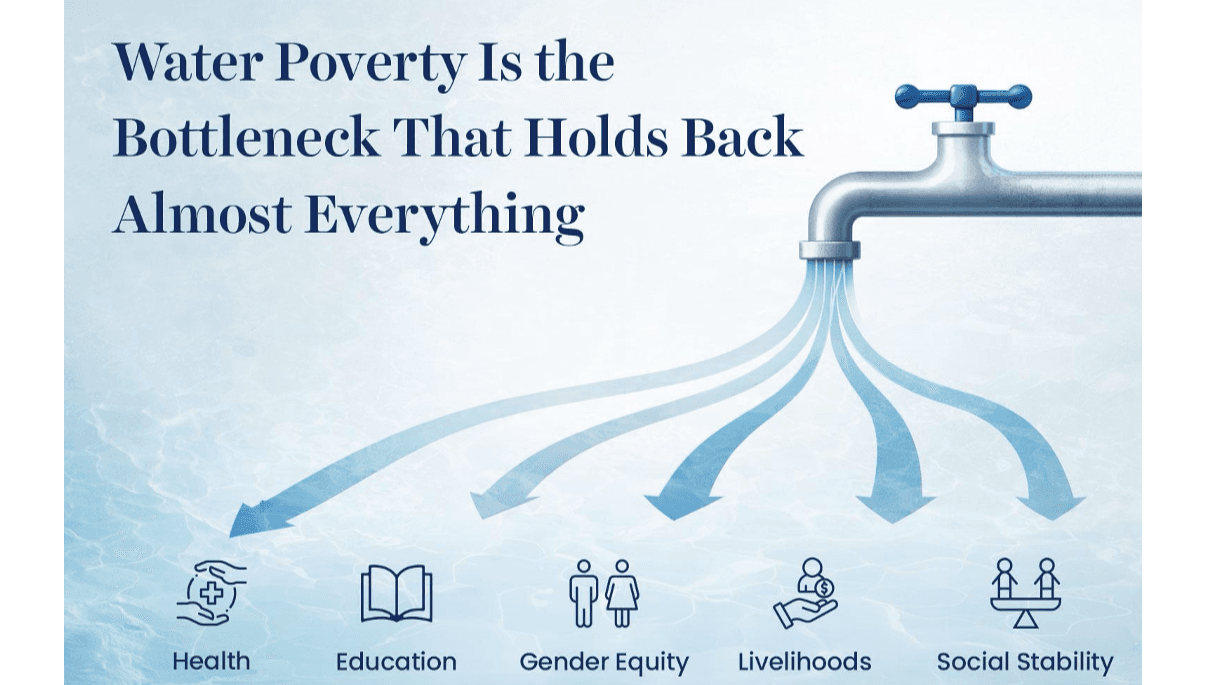
Water Poverty Is the Bottleneck That Holds Back Almost Everything
Written by Sam Adeoti, CEO at Fairaction
At first glance, water poverty can look like a single-sector problem: a missing borehole, an unreliable pump, a queue at a river. In reality, it is one of the highest-leverage constraints on human development because it sits upstream of what most funders are trying to achieve: better health outcomes, stronger education, gender equity, resilient livelihoods, and social stability.
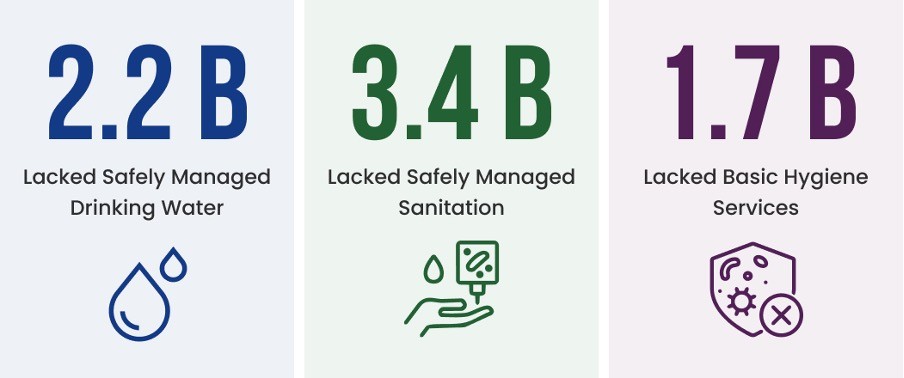
In 2024, UN reporting stated that 2.2 billion people still lacked safely managed drinking water, 3.4 billion lacked safely managed sanitation, and 1.7 billion lacked basic hygiene services at home [1].
UN SDG reporting also shows that 1.8 billion people had no on-premises drinking water, and that women are primarily responsible for water collection in two out of three households, reinforcing gendered time poverty [2].
Fairaction International exists because water poverty is not only an engineering problem. It is a systems problem. It requires an integrated delivery model that keeps services functional, used, and financially viable, while maintaining governance integrity and transparent reporting.
Why funders should treat water poverty as a cross-cutting development lever
If you fund outcomes in health, education, equality, livelihoods, and climate resilience, water poverty is often the binding constraint. This is why water interventions can move multiple SDGs and CSR priorities simultaneously.
Health and human capital. WHO states that improving access to water, sanitation, and hygiene can save 1.4 million lives per year [3].
Education and time poverty. When water is distant or unsafe, illness and time spent collecting water directly reduce learning time and attendance. The gendered burden of water collection is documented in SDG reporting, with women primarily responsible in two out of three households without on-premises water [2]
Poverty reduction and productivity. The same dynamics that increase disease and reduce education also suppress productivity and household income. In practice, water poverty often functions as an opportunity tax on the poorest households, paid through time loss, health shocks, and constrained mobility.
Nigeria illustrates the challenge, but Fairaction’s mission is global
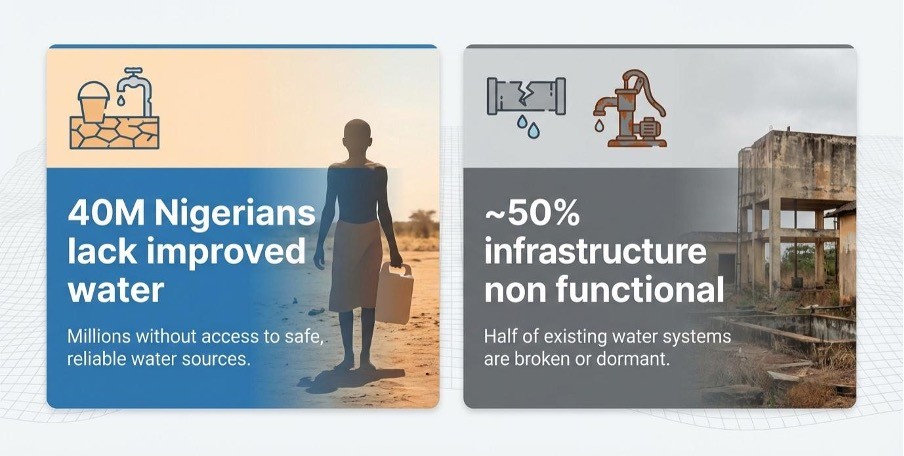
Nigeria exemplifies the water access and infrastructure sustainability challenge. More than 40 million Nigerians lack access to improved water sources, and nearly half of water infrastructure assets are non-functional or failed [4]
Fairaction’s mission is global, and our expansion pathway is deliberate. We continue to strengthen delivery and R&D in Nigeria and Australia while preparing to expand into new regions through a staged approach that proves what works before scaling. In each new geography, we begin by engaging potential partners and establishing the funding base required for high-quality delivery. We then run a pilot to generate real-world evidence in that local context. After the pilot, we adapt and refine our sustainability framework using the data and lessons learned, ensuring the model is context-specific to the technical, socio-economic, cultural, and institutional realities of that location. From there, we convert validated lessons into a replicable blueprint, establish the local operating structure required for long-term governance and accountability, and then scale.
For venture philanthropists and institutional funders, this sequencing matters. It reduces delivery risk, strengthens evidence for impact, and creates a clear pathway from pilot performance to scalable, investable outcomes.
The uncomfortable truth: many water projects fail early
The core risk in the water sector is not whether an asset can be installed. It is whether the service still functions after the ribbon cutting.
A World Bank analysis of Nigeria’s improved water points found that more than 38% of improved water points were nonfunctional, and that nearly 27% were likely to fail in the first year [5].
Fairaction’s position is therefore built around a funder-relevant question: how do we design water services so they keep working, and so performance can be verified over time?
Why conventional solutions fail: complexity is real, and it is measurable
Failure is rarely caused by a single issue. A systematic literature review identified 265 distinct factors contributing to water infrastructure failure, spanning technical, financial, environmental, social, political, and institutional domains [6]
A funder-relevant takeaway is straightforward: if failure is multi-factor and systemic, then the response must be multi-factor and systemic, with evidence, measurement, and feedback loops.
The Fairaction proposition: treat water delivery as a science of sustainability
Fairaction’s approach is built around an iterative research and development cycle: research, conceptualisation, piloting, data collection, analysis, refinement, and repetition (Fairaction, How We Work). https://fairaction.ngo/en/about/how-we-work
This cycle is designed to deliver three outcomes that funders consistently demand:
Reduce early failure risk through stronger pre-construction decision-making, including context-specific feasibility assessment and design optimisation.
Generate measurable evidence through continuous monitoring that strengthens performance and accountability over time.
Demonstrate empirical improvement by using pilot results to refine the framework and strengthen sustainability and reliability across deployments over time
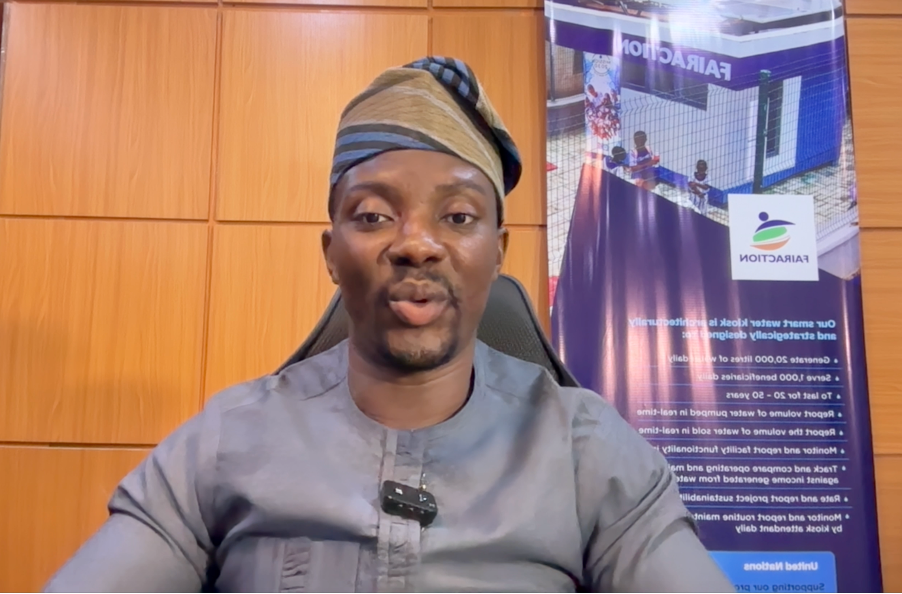 Watch Fairaction’s CEO explain how we work: https://youtu.be/s5Xx8iFeC2E
Fairaction also strengthens transparency by making project information accessible through the Target 6.1 Map, enabling external stakeholders to view and verify project records online. https://target6.1map.management/
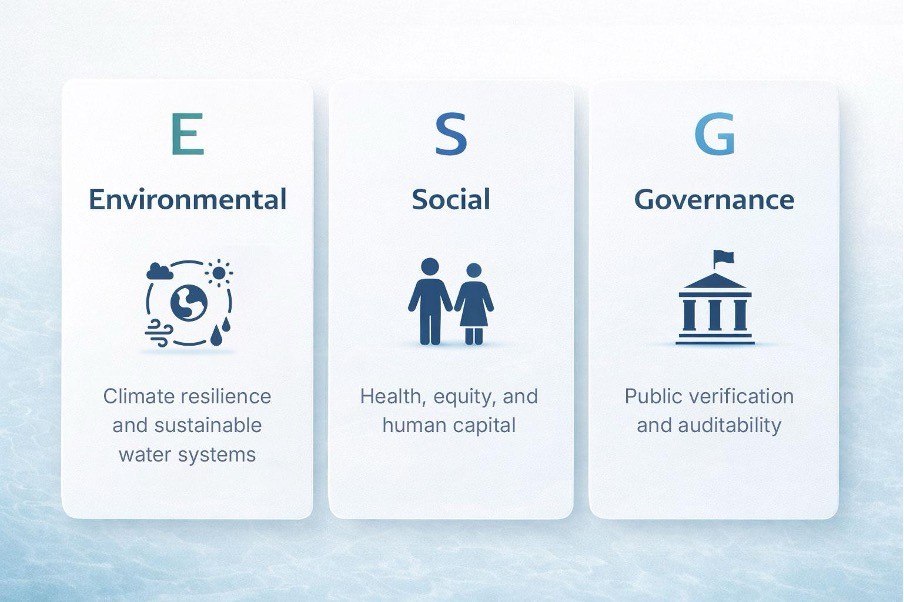
ESG alignment: how Fairaction helps funders meet their objectives
Environmental (E). Water scarcity and service failure are material environmental risks, especially where climate variability amplifies supply uncertainty. The UN frames access to sustainable water and sanitation services as central to climate resilience and sustainable development [1]
Social (S). Fairaction targets measurable social outcomes linked to health, equity, and human capital. Global benchmarks show the scale of unmet need [2]. WHO quantifies avoidable mortality linked to inadequate WASH [3]
Governance (G). ESG governance increasingly demands auditability. Fairaction’s Target 6.1 Map is publicly accessible, enabling external verification rather than narrative-only assurance.
Fairaction International is positioned for funders who want more than installations. We are designed for those who want durable services, measurable outcomes, and transparent evidence.
If you are a venture philanthropist, foundation, corporate ESG leader, CSR decision-maker, or grantor focused on poverty reduction and human development, partnership pathways include:
Multi-year scaling partnerships to replicate proven models across geographies, using a staged approach that builds readiness and evidence before scale.
Systems funding for mapping, monitoring, evaluation, and governance mechanisms that prevent early failure and strengthen accountability.
In-kind capability contributions such as engineering, monitoring and evaluation, data science, governance support, and strategic partnerships to accelerate scale without compromising quality.
To explore partnership opportunities and see the transparency system in action, please email us at Partnership@fairaction.ngo
Stay Connected
Want more evidence-backed insights from the field? Subscribe for more articles like this and get future reports in your feed.
Also, follow Fairaction International for field-related reports on sustainable water solutions, project updates, and measurable outcomes: linkedin.com/company/fairactioninternational/
Acknowledgement
Fairaction acknowledges that research partnerships are central to our ability to deliver sustainable, monitored water services. Our research is funded by Clean Water for All Pty Ltd (CWFA) and led by Fairaction International. Implementation is carried out in Nigeria through our subsidiary, Fairaction Nigeria.
Reference
[1] United Nations. (n.d.). Goal 6: Clean water and sanitation. https://www.un.org/sustainabledevelopment/water-and-sanitation/
[2] United Nations Statistics Division. (2024). The Sustainable Development Goals Report 2024: Goal 6. https://unstats.un.org/sdgs/report/2024/Goal-06/
[3] World Health Organization. (2023, June 28). Improving access to water, sanitation and hygiene can save 1.4 million lives per year. https://www.who.int/news/item/28-06-2023-improving-access-to-water--sanitation-and-hygiene-can-save-1.4-million-lives-per-year--says-new-who-report
[4] Adeoti, O. S., & Vigneswaran, S. (2025, February 12). Smart solutions: a Nigerian answer to access. The Source (International Water Association). https://thesourcemagazine.org/smart-solutions-a-nigerian-answer-to-access/
[5] Andres, L. A., Chellaraj, G., Gupta, B. D., Grabinsky, J., & Joseph, G. (2018). Why are so many water points in Nigeria non-functional? An empirical analysis of contributing factors (World Bank policy research working paper page). https://documents1.worldbank.org/curated/en/363491522264585702/pdf/WPS8388.pdf
[6] Adeoti, O. S., Kandasamy, J., & Vigneswaran, S. (2023). Water infrastructure sustainability in Nigeria: a systematic review of challenges and sustainable solutions. https://doi.org/10.2166/wp.2023.173
Join the Movement
If every child deserves a classroom, every classroom deserves clean water.
No child should walk miles for water before learning the alphabet.
No girl should drop out because her school cannot manage her dignity.
No community should be left behind by dry taps and broken toilets.
Together, we can change this.
💧 Join the Water and Education Alliance.
You can donate to Fairaction today to bring clean water, dignity, and hope to classrooms across Africa.
👉 Contact Us to Collaborate.