

Water and SDG 2: Why Zero Hunger Depends on Reliable Water Service
Written by Sam Adeoti, CEO at Fairaction
Hunger and malnutrition are off track. Around 673 million people experienced hunger in 2024 and around 150 million children under five remain stunted, with progress projected to fall well short of the 2030 targets. This article argues that the unfinished business of water service is at the heart of why food security and nutrition outcomes have stalled. Reliable drinking water shapes nutrition through the gut, not only through what is on the plate. Agricultural water systems built but not maintained produce nothing in the seasons when food is most needed. We make the case that funding services rather than assets, treating drinking water as nutrition infrastructure, and demanding transformative rather than incremental WASH are the conditions for SDG 2 progress.
The world is moving backward on hunger. Around 673 million people experienced hunger in 2024 and projections point to 512 million still hungry in 2030, nearly 60 per cent of them in Africa. Reliable water service is not a side issue in this picture. Food production depends on it, food safety depends on it, and the most stubborn forms of malnutrition turn out to depend on it too. The harder question, which this article takes on, is why a generation of irrigation expansion and rural water investment has not converted into the food security gains that the headline figures of agricultural water use seem to promise, and what a durable water-service alternative would look like.
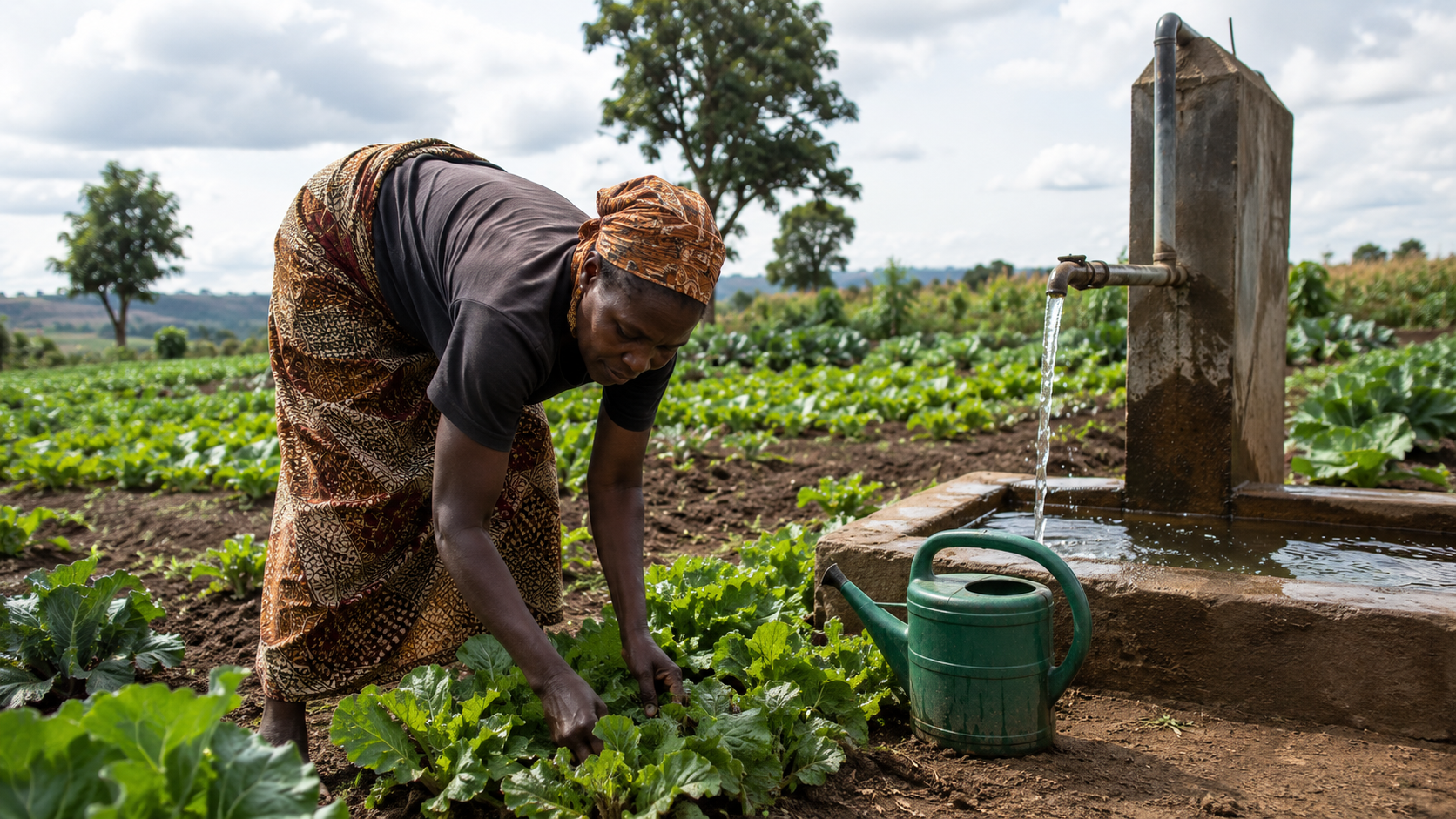 Reliable water service changes daily life. At a Fairaction water kiosk, women collect water from a system designed to keep working beyond construction, because lasting access, not one off installation, is what supports poverty reduction.
Key Takeaways
- Water and SDG 2 are linked through production, nutrition and resilience. Reliable water affects what households can grow, how safely food is prepared, and whether children can absorb nutrients.
- Hunger and malnutrition remain off track. Around 673 million people experienced hunger in 2024, and roughly 150 million children under five remain stunted.[1]
- Safe water is nutrition infrastructure. Repeated exposure to unsafe water and poor sanitation contributes to diarrhoeal disease and environmental enteric dysfunction, both of which undermine child growth.[7]
- Clean water access only matters when service lasts. A borehole, kiosk or piped system supports food security only while it continues to provide safe, affordable and reliable water.
- Transformative WASH is a service-quality challenge. The best interpretation of the WASH Benefits and SHINE trials is that modest household-level improvements are insufficient in high-exposure environments.[10][11]
- FairAction applies a research-led water charity model. Its work focuses on sustainable water projects, local capacity-building, smart water kiosks and water service sustainability rather than one-off asset installation.
14 min read
Why water and SDG 2 belong in the same conversation
FairAction's mission is to help achieve SDG 6.1: universal and equitable access to safe and affordable drinking water for all. SDG 2 sits immediately next to that work. Ending hunger and securing universal safe water access are the same household challenge viewed from different angles.
The water deprivation that prevents communities from drinking safely is often the same deprivation that limits what households can grow, how livestock are watered, how much time women and girls lose to collection, and whether food can be prepared without exposing children to infection. The places where SDG 6.1 is hardest to deliver are often the places where SDG 2 is most stuck.
That is why safe water, clean water and sustainable water services are not simply WASH-sector concerns. They are food-security concerns. They are nutrition concerns. They are also donor-accountability concerns, because water projects that fail after construction do not continue reducing hunger.
For FairAction, the connection is direct. A lasting water service can support child growth, reduce disease exposure, protect household time and strengthen resilience. A failed water point cannot. This is the practical difference between building water infrastructure and delivering water service sustainability.
Where hunger and malnutrition sit today
The latest global figures remain sobering. The 2025 edition of The State of Food Security and Nutrition in the World, produced by FAO, IFAD, UNICEF, WFP and WHO, estimated that around 673 million people experienced hunger in 2024. That is 8.2 per cent of the global population, a modest improvement from 2023 but still well above the pre-pandemic level.[1]
The geography matters. Hunger continued to rise across most of Africa and Western Asia. Africa's hunger prevalence surpassed 20 per cent in 2024, affecting 307 million people. If current trajectories hold, around 512 million people will still be chronically undernourished in 2030, nearly 60 per cent of them in Africa.[1] SDG 2 will not be met on the current trajectory.
Acute food insecurity tells the same story more sharply. The 2025 Global Report on Food Crises found that around 295 million people across 53 countries faced acute food insecurity in 2024, the sixth consecutive annual increase and the highest absolute number in the report's nine-year history.[2] Conflict and weather extremes remain the dominant drivers. Recent updates have also pointed to catastrophic levels of food insecurity in the worst-affected contexts.[3]
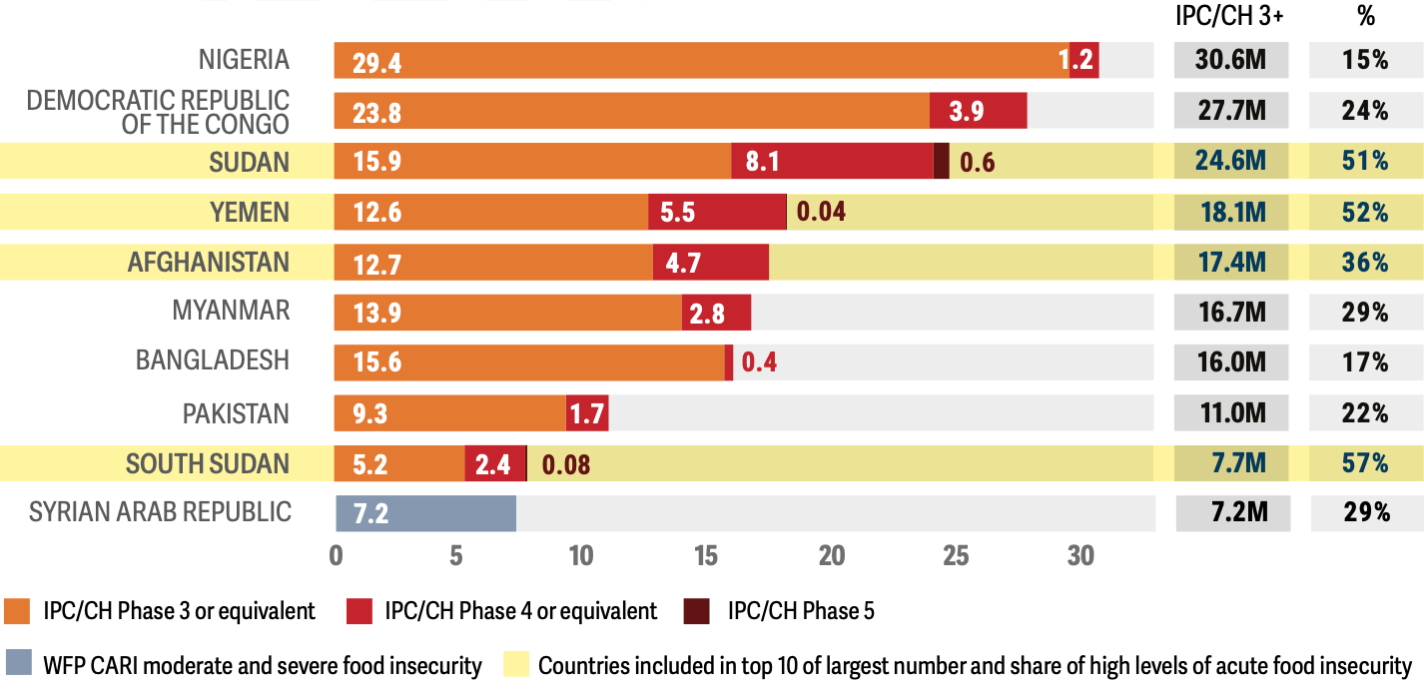 Countries with the largest numbers of people facing high levels of acute food insecurity show why SDG 2 remains off track in fragile and climate-affected contexts.
Child malnutrition follows the same pattern. Stunting prevalence among children under five fell from 26.4 per cent in 2012 to 23.2 per cent in 2024, but 150.2 million children remain stunted, and the world is not on track to meet the 2030 nutrition targets.[1] In Nigeria, recent Demographic and Health Survey analysis found national stunting prevalence of around 41.5 per cent, rising above 60 per cent in some northern states.[4]
This is the context for asking what role water plays. Water poverty in Nigeria, water access in underserved communities and WASH sustainability are not side issues within the hunger picture. They are part of the core diagnosis.
How water insecurity drives hunger, food insecurity and stunting
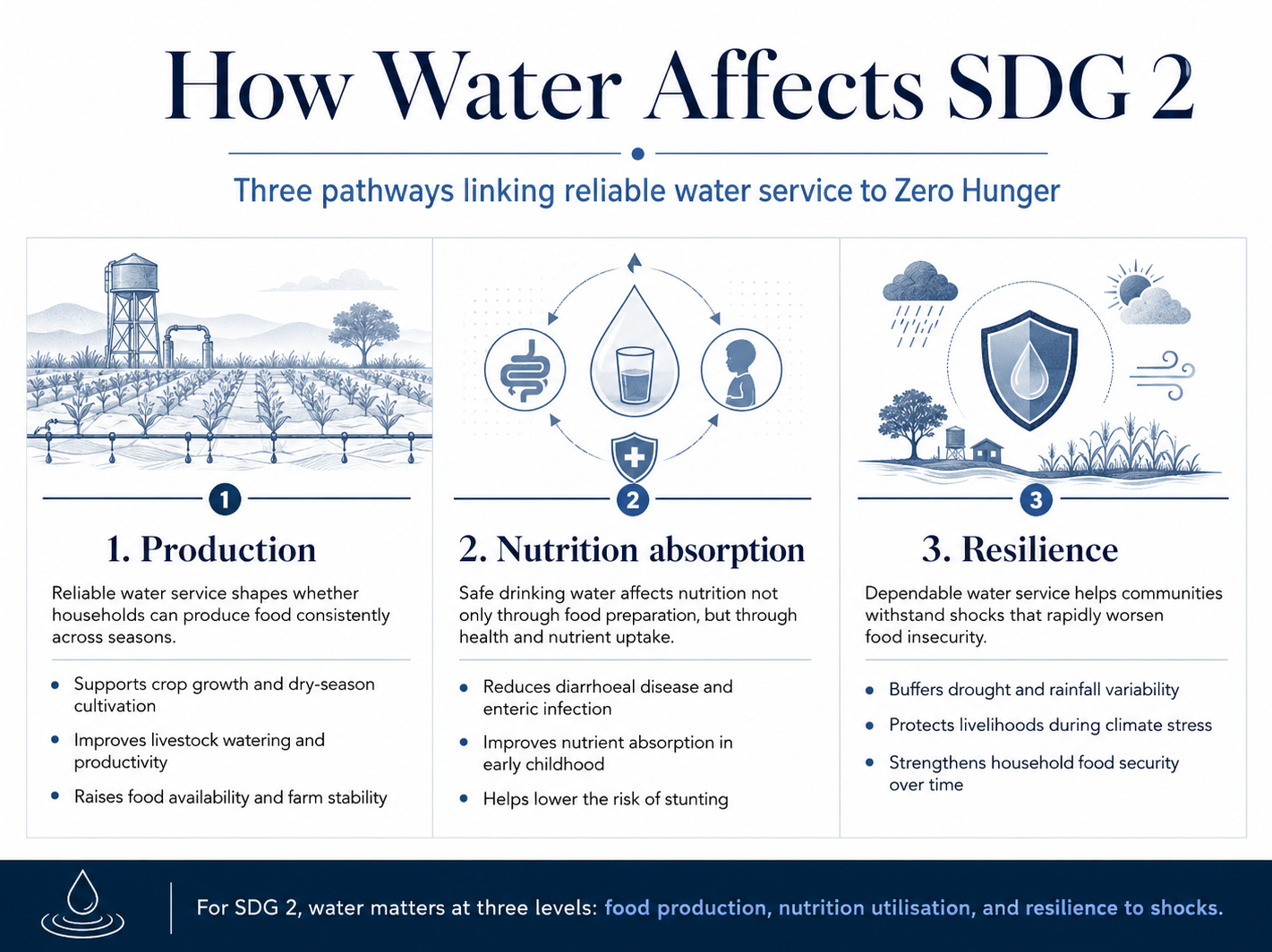 Water does not affect hunger through one pathway. It sits inside the food-security system at several points at once.
Water supports food production
On the production side, agriculture is the world's largest water user, accounting for around 70 per cent of global freshwater withdrawals.[5] Around 90 per cent of agriculture in sub-Saharan Africa is rain-fed, leaving smallholder farmers exposed to drought, erratic rainfall and climate volatility.[6]
Water reliability is therefore not a marginal agronomic concern. It is one of the main variables separating a household that can produce food year-round from one that cannot. Sustainable water projects and community water projects matter because they can reduce this exposure when they continue to function beyond the handover date.
This is especially important for water projects in Nigeria and other settings where climate variability, rural poverty and weak infrastructure overlap. Food production depends not just on building water assets, but on keeping water services operational during the seasons when households need them most.
Safe water supports nutrition
On the consumption side, the link runs through nutrition rather than calories alone. Repeated diarrhoeal disease in early childhood can damage the gut lining and impair nutrient absorption, a condition known as environmental enteric dysfunction.[7] A child can consume sufficient calories and still fail to grow because nutrients are not being absorbed properly.
This is the mechanism that connects unsafe water and poor sanitation directly to childhood stunting. It is also why safe water should be treated as nutrition infrastructure. Clean water does not replace food, but without it, food interventions can underperform because the child's exposure environment remains unchanged.
In Nigeria, around 70 per cent of children lack access to basic WASH facilities, which helps explain why stunting remains concentrated where poor WASH conditions overlap with food insecurity.[8] SDG Target 2.2, on ending malnutrition, cannot be met by food interventions alone.
Reliable water protects household resilience
On the resilience side, water-driven shocks compound food insecurity quickly. Drought reduces yields, kills livestock and forces distress sales of productive assets. Floods destroy stored harvests and contaminate water sources, creating a secondary wave of disease and malnutrition. Weather extremes pushed 18 countries into food crises affecting more than 96 million people in 2024.[2]
The household-level mechanisms are clear. Reliable water services affect food security through crops, livestock, disease exposure, time use, household expenditure and climate risk. This is why water and food security should be planned together rather than funded as separate silos.
Why progress depends on water service sustainability
The right response to the sustainability problem is not to dismiss the institutions and national programmes that have expanded water access, irrigation and WASH coverage. Much of this work has saved lives, increased production and reduced deprivation.
The global hunger trajectory, while still off track, is not uniform. Southern Asia and Latin America have seen improvements in undernourishment prevalence over the past decade, with Asia falling from 7.9 per cent in 2022 to 6.7 per cent in 2024 and Latin America falling to 5.1 per cent.[1] Stunting prevalence is down globally by more than three percentage points since 2012.[1]
National irrigation programmes in India, Ethiopia and parts of West Africa have brought many smallholders within reach of more reliable agricultural water. The FAO's Global Framework on Water Scarcity in Agriculture has also mainstreamed the conversation about agricultural water productivity across a broad coalition of country and institutional partners.[9]
Most of the institutions cited in this article are part of the solution: FAO, IFAD, UNICEF, WFP, WHO, the World Bank, national agriculture ministries and the wider WASH sector. The progress that has been made is real. The question is what happens after installation, and whether access becomes continuing service.
The challenge the sector has not yet solved
 The hardest finding in the recent WASH and nutrition literature is also the most important. Between 2018 and 2019, three large cluster-randomised trials - WASH Benefits Bangladesh, WASH Benefits Kenya, and the Sanitation, Hygiene and Infant Nutrition Efficacy trial in Zimbabwe - tested whether household-level WASH interventions, alone or combined with infant feeding support, would reduce child stunting. In all three trials, the WASH interventions did not produce statistically significant improvements in linear growth, and the combined WASH-plus-feeding arms did not outperform feeding alone.[10]
That result should not be interpreted as evidence that WASH does not matter for nutrition. The stronger interpretation is that modest, household-level WASH improvements are insufficient in settings where children face heavy and continuous exposure to faecal pathogens. What works is more likely to be transformative WASH: comprehensive, sustained water and sanitation services tailored to the local exposure landscape.[11]
A natural experiment in rural Gambia reinforces the point. Stunting was only eliminated above a substantial socio-economic and environmental threshold, suggesting that incremental improvements below that threshold may not move the needle.[12]
The agricultural side of SDG 2 has its own version of the same problem. Widely cited claims that irrigation accounts for around 70 per cent of freshwater withdrawals and contributes around 40 per cent of food production are now being examined more carefully. A recent citation-network analysis found that many references to these numbers did not lead to supporting empirical data, and that the actual range for irrigated grain production may be much wider than the conventional figure implies.[13]
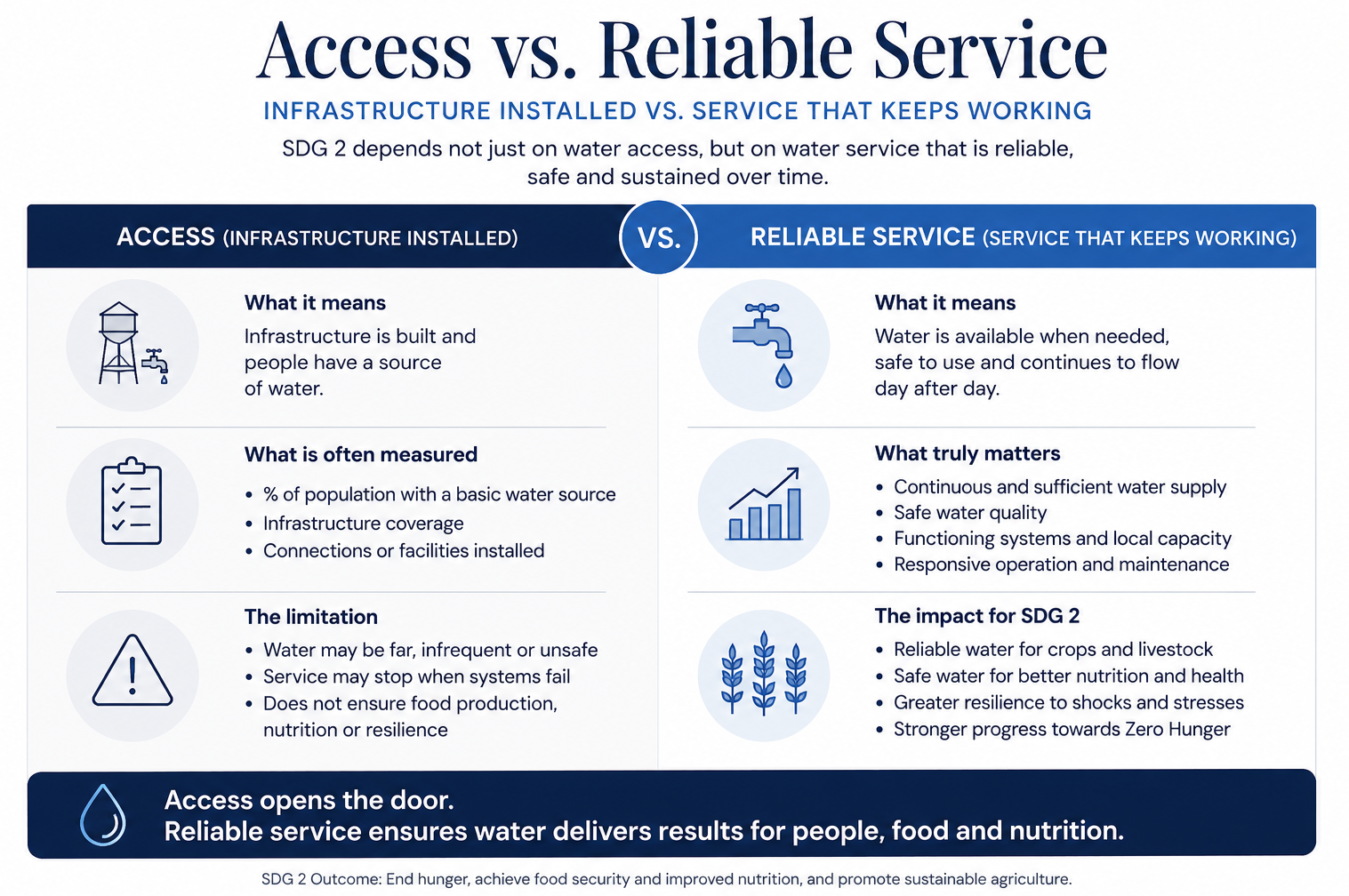
The point is not that irrigation is unimportant. It is that headline access or infrastructure numbers can conceal uneven service performance. An irrigation scheme that is dry in the season it is most needed, a borehole that fails within three years of installation, a piped system that delivers water two days a week, none of these produces the food security and nutrition gains that the access statistics suggest they should. The post-construction decay curve that defines the rural water sector also defines its food and nutrition outcomes.
Installation is not impact. Water systems support SDG 2 only while reliable service continues.
Three sector debates FairAction takes a position on
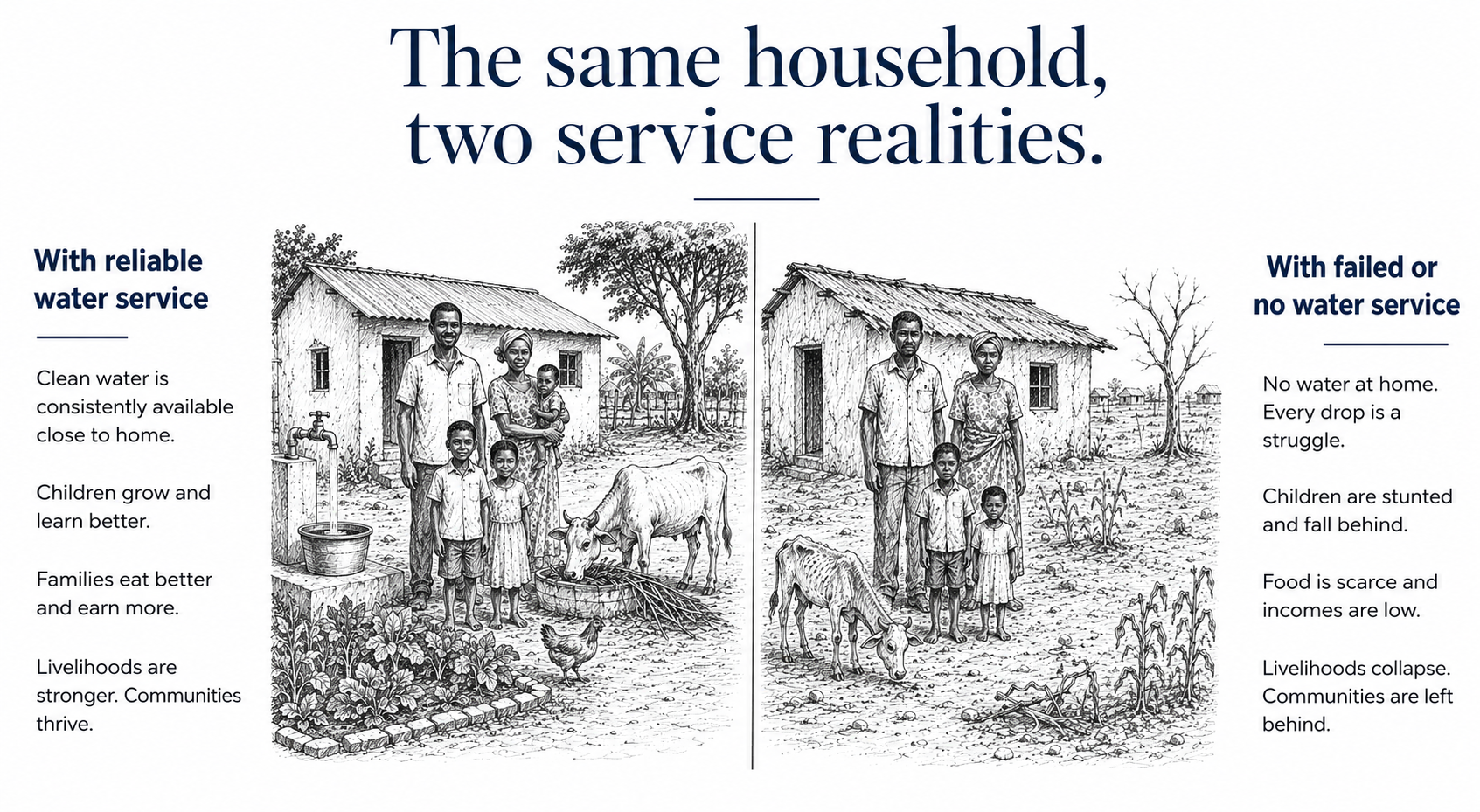 There are several recurring debates in the water and food-security space where polite consensus is comfortable and the evidence is not. FairAction's view is that it is more useful to be explicit about which positions make lasting food and nutrition gains possible.
Safe water as nutrition policy
The conventional split treats hunger as a food problem and drinking water as a hygiene problem. That split fails at the most consequential point. A significant fraction of childhood stunting is shaped by the water and sanitation environment in which a child grows up, not only by what is on the plate.
FairAction's position is that safe drinking water service should be treated as nutrition infrastructure, on equal footing with supplementary feeding programmes. Nutrition strategies that finance food interventions while assuming the WASH environment will fix itself are designing for ceiling effects they will later describe as implementation failure.
Incremental WASH versus transformative WASH
The WASH Benefits and SHINE trials changed the sector because they made an uncomfortable distinction unavoidable. Modest household-level WASH improvements are not the same as a transformed exposure environment.
FairAction's position aligns with the post-trial consensus: nutrition-relevant WASH has to be comprehensive, sustained and locally tailored. A single handpump installed and walked away from is not transformative. A serviced, monitored and professionally maintained water system that operates across a substantial share of a child's first thousand days is much closer to the standard the evidence implies.
This is where WASH sustainability becomes a food-security issue. The cost per nutrition-relevant unit of WASH is higher than headline construction budgets suggest because the relevant unit is not an installed asset. It is a sustained service environment.
Hardware-led food security versus service-led food security
Most agricultural water investment is still measured in irrigation hectares developed, boreholes drilled or pumps distributed. FairAction's position is that this is the same construction-led logic that has produced the rural water functionality crisis, applied to the food-security sector.
An irrigation scheme that is non-functional during the dry season contributes nothing to household food security. A livestock water point that runs out of repair money in year three contributes nothing to pastoralist resilience. The relevant unit of measurement is years of working service delivered, not units installed.
Donors, governments and water actors serious about SDG 2 should require service-continuity reporting alongside infrastructure reporting. They should also be willing to finance the recurring operating costs that determine whether infrastructure continues to produce food and nutrition gains.
What FairAction does differently
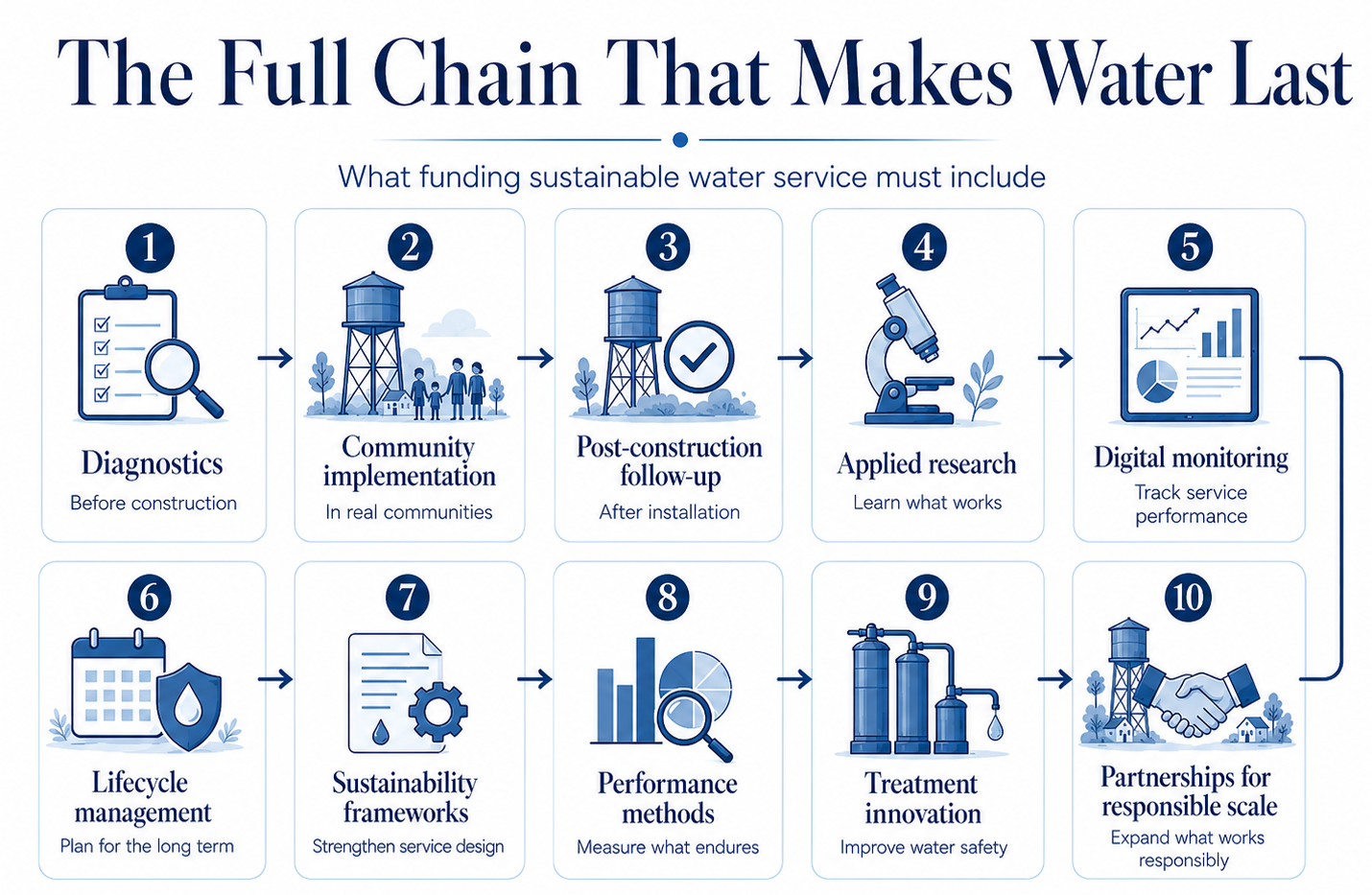 FairAction's contribution to SDG 2 works through the drinking-water side, where its domain authority is strongest. FairAction is a research-led water charity focused on safe water, sustainable water services and community water projects that continue after construction.
The FairAction Model is designed against a common failure mode in rural water delivery: infrastructure is built, celebrated and then left without the financing, local capacity or monitoring needed to keep it working. FairAction's approach runs in three phases.
Before construction: research-led design
Before construction, the work is diagnostic. Communities are mapped using the open Target 6.1 Map, a Predictive Iterative Sustainability assessment evaluates whether a proposed project can be operationally and financially viable in that specific community, and architectural designs are built against a defined infrastructure lifespan rather than a short fundraising cycle.[14]
This pre-construction mapping helps ensure that sustainable water projects are not selected only because a community needs water. They are selected and designed because the service model can plausibly last.
During construction: community capacity-building
During construction, the work is preparatory for service. Local technicians are trained in maintenance and repair, communities are educated on usage and operation, a local water committee is established, and a kiosk attendant is employed from within the community.[14]
This matters for SDG 2 because lasting water service is partly a governance and capacity problem. A community water project cannot support nutrition or food security if no one is trained, paid or responsible for keeping it operational.
After construction: monitoring and operations
After construction, the work is operational. Solar-powered smart water kiosks combine flow sensors and automatic shutdown devices with affordable per-litre pricing set by the community, water credits for households unable to pay, and IoT monitoring that captures performance data continuously.[14]
Surplus from water sales is reinvested into operation and maintenance. The goal is less than one per cent downtime over the infrastructure's lifespan, because the nutrition and food-security value of water depends on continuity.[14]
This is the distinction between a water charity that funds assets and a research-led water charity that funds services. The aim is not simply to install a kiosk. The aim is to deliver safe water services that continue to support household health, time use, resilience and nutrition year after year.
The relevance to SDG 2 is direct. A water system that delivers continuous safe drinking water across the first thousand days of a child's life is one of the necessary conditions for reducing the diarrhoeal episodes that contribute to environmental enteric dysfunction and stunting. Reliable household water also saves time that can be reallocated toward childcare, food preparation, markets and productive work.
None of this happens in a system that has been built and abandoned. All of it depends on the operating model that follows construction.
What this means for SDG 2
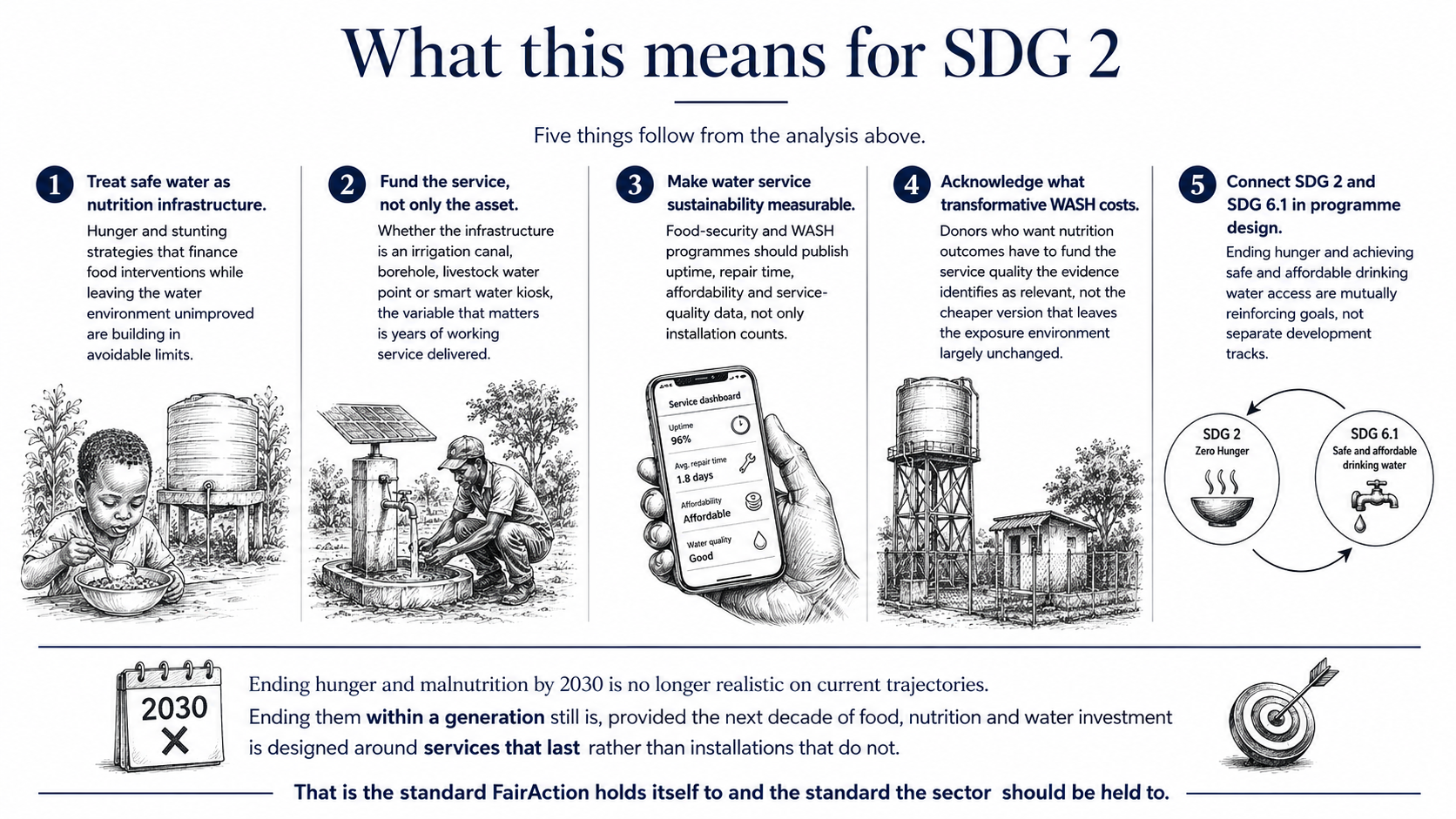 Five things follow from the analysis above.
Treat safe water as nutrition infrastructure. Hunger and stunting strategies that finance food interventions while leaving the water environment unimproved are building in avoidable limits.
Fund the service, not only the asset. Whether the infrastructure is an irrigation canal, borehole, livestock water point or smart water kiosk, the variable that matters is years of working service delivered.
Make water service sustainability measurable. Food-security and WASH programmes should publish uptime, repair time, affordability and service-quality data, not only installation counts.
Acknowledge what transformative WASH costs. Donors who want nutrition outcomes have to fund the service quality the evidence identifies as relevant, not the cheaper version that leaves the exposure environment largely unchanged.
Connect SDG 2 and SDG 6.1 in programme design. Ending hunger and achieving safe and affordable drinking water access are mutually reinforcing goals, not separate development tracks.
Ending hunger and malnutrition by 2030 is no longer realistic on current trajectories. Ending them within a generation still is, provided the next decade of food, nutrition and water investment is designed around services that last rather than installations that do not. That is the standard FairAction holds itself to and the standard the sector should be held to.
--
References
[1] FAO, IFAD, UNICEF, WFP and WHO, The State of Food Security and Nutrition in the World 2025 (SOFI 2025), summarised in FAO joint news release, July 2025. https://www.fao.org/newsroom/detail/global-hunger-declines--but-rises-in-africa-and-western-asia--un-report/en
[2] Global Network Against Food Crises, Global Report on Food Crises 2025, May 2025. https://www.fightfoodcrises.net/articles/2025-global-report-food-crises-acute-food-insecurity-and-malnutrition-rise-sixth
[3] Joint Research Centre, European Commission, Food crises: no respite as 1.4m people suffer the most severe level of food insecurity in 2025, April 2026. https://joint-research-centre.ec.europa.eu/jrc-news-and-updates/food-crises-no-respite-14-m-people-suffer-most-severe-level-food-insecurity-2025-2026-04-24_en
[4] Ahmed, K. Y., Ross, A. G., Hussien, S. M., Agho, K. E., Olusanya, B. O., Ogbo, F. A. (2023). Mapping Local Variations and the Determinants of Childhood Stunting in Nigeria. International Journal of Environmental Research and Public Health, 20(4), 3250. https://www.mdpi.com/1660-4601/20/4/3250
[5] FAO, Water Scarcity Management: Addressing water scarcity in agriculture and food systems. https://openknowledge.fao.org/items/010ff17a-d08e-46c8-96dc-364b9fea072d
[6] Frontiers in Sustainable Food Systems, Innovations and policies for climate-resilient food and water systems in sub-Saharan Africa: a systematic review, 2026. https://www.frontiersin.org/journals/sustainable-food-systems/articles/10.3389/fsufs.2026.1796985/full
[7] Harper, K. M. et al., Environmental enteric dysfunction pathways and child stunting: a systematic review, PLOS Neglected Tropical Diseases, 2018. https://journals.plos.org/plosntds/article?id=10.1371%2Fjournal.pntd.0006205
[8] Victor, C., Kupoluyi, J. A., Oyinlola, F. F., Sule, V. O. (2025). Prevalence and factors associated with water, sanitation and hygiene (WASH) facilities deprivation among children in Nigeria. BMC Pediatrics 25:102. https://bmcpediatr.biomedcentral.com/articles/10.1186/s12887-025-05463-5
[9] FAO, Global Framework on Water Scarcity in Agriculture (WASAG). https://www.fao.org/newsroom/detail/water-scarcity-means-less-water-for-agriculture-production-which-in-turn-means-less-food-available-threatening-food-security-and-nutrition/en
[10] Cumming, O., Arnold, B. F., Ban, R., Clasen, T., Mills, J. E., Freeman, M. C., et al. (2019). The implications of three major new trials for the effect of water, sanitation and hygiene on childhood diarrhea and stunting: a consensus statement. BMC Medicine 17:173. https://bmcmedicine.biomedcentral.com/articles/10.1186/s12916-019-1410-x
[11] Wilson-Jones, M., Smith, K., Jones, D., Hamilton, H., Richardson, L., Macintyre, A., Gautam, O. P., Harvey, E., Northover, H. (2019). Response to ‘The implications of three major new trials for the effect of water, sanitation and hygiene on childhood diarrhea and stunting: a consensus statement’ by Cumming et al. BMC Medicine 17:183. https://bmcmedicine.biomedcentral.com/articles/10.1186/s12916-019-1414-6
[12] Husseini, M., Darboe, M. K., Moore, S. E., Nabwera, H. M., Prentice, A. M. (2018). Thresholds of socio-economic and environmental conditions necessary to escape from childhood malnutrition: a natural experiment in rural Gambia. BMC Medicine 16:199. https://bmcmedicine.biomedcentral.com/articles/10.1186/s12916-018-1179-3
[13] Puy, A., Linga, S. N., Wei, N., Flinders, S., Callow, B., Allen, G., Cross, B., Aguiló-Rivera, C., Lankford, B. (2025). Widely cited global irrigation statistics lack empirical support. PNAS Nexus 4(11):pgaf323. https://academic.oup.com/pnasnexus/article/4/11/pgaf323/8320029
[14] FairAction International, How We Work. https://fairaction.ngo/about/how-we-work
Frequently asked questions
Through three distinct pathways. On the production side, around 70 per cent of global freshwater is used for agriculture, and rain-fed smallholder farming, which dominates sub-Saharan Africa, is highly vulnerable to drought. On the consumption side, unsafe drinking water and poor sanitation cause repeated diarrhoeal disease in young children, which damages the gut and prevents the absorption of nutrients even when calories are sufficient. On the resilience side, water-driven shocks like droughts and floods compound food insecurity faster than any other type of shock.
It is a subclinical condition of the small intestine caused by chronic exposure to faecal pathogens, common in environments with poor water and sanitation. It damages the intestinal lining and reduces the body's ability to absorb nutrients, which contributes to childhood stunting independently of food intake. It is one of the principal reasons that nutrition interventions alone do not eliminate stunting in poor WASH environments.
No. They showed that the specific modest, household-level WASH interventions tested in those trials did not reduce stunting in those settings. The consensus interpretation among the principal investigators and the wider field is that transformative WASH, comprehensive and sustained water and sanitation services tailored to the local exposure landscape, is what is needed. Incremental household-level improvements are insufficient.
Continuous safe drinking water during the first thousand days of a child's life reduces the diarrhoeal disease that drives environmental enteric dysfunction, which is one of the main drivers of childhood stunting in low-income settings. Reliable household water service also frees women's time, which evidence shows reallocates toward childcare, market activities, and food preparation. Both are direct contributions to SDG 2 outcomes.
Because food and nutrition outcomes depend on how long a water system continues to deliver service, not on whether it was installed. An irrigation scheme that is dry when it is most needed produces no food. A borehole that fails within three years of installation produces no continuing nutrition benefit. The relevant unit of measurement is years of working service delivered.
Join the Movement
If every child deserves a classroom, every classroom deserves clean water.
No child should walk miles for water before learning the alphabet.
No girl should drop out because her school cannot manage her dignity.
No community should be left behind by dry taps and broken toilets.
Together, we can change this.
💧 Join the Water and Education Alliance.
You can donate to Fairaction today to bring clean water, dignity, and hope to classrooms across Africa.
👉 Contact Us to Collaborate.