

Water and SDG 1: How Sustainable Water Service Reduces Poverty
Written by Sam Adeoti, CEO at Fairaction
Water and poverty are more tightly connected than most development narratives allow. If SDG 1 is about ending poverty in all its forms, then reliable water service is not a side issue. It is part of how poverty is measured, part of how households fall deeper into deprivation, and part of why progress on poverty stalls when water systems fail. The evidence is clear: safe water can reduce disease, save time, and improve income opportunities. But the poverty-reduction effect of water depends on something the sector often treats as secondary: whether service continues after construction. A water point that breaks down after a few years does not deliver the same welfare gains as a service that remains reliable, affordable, and safe over time. This is the central argument of this article. Access expansion matters, but access alone is not enough. To reduce poverty meaningfully, water investment has to move beyond installation counts and focus on service sustainability. That means financing maintenance, monitoring performance, building local repair capacity, and designing systems that keep working long after launch.
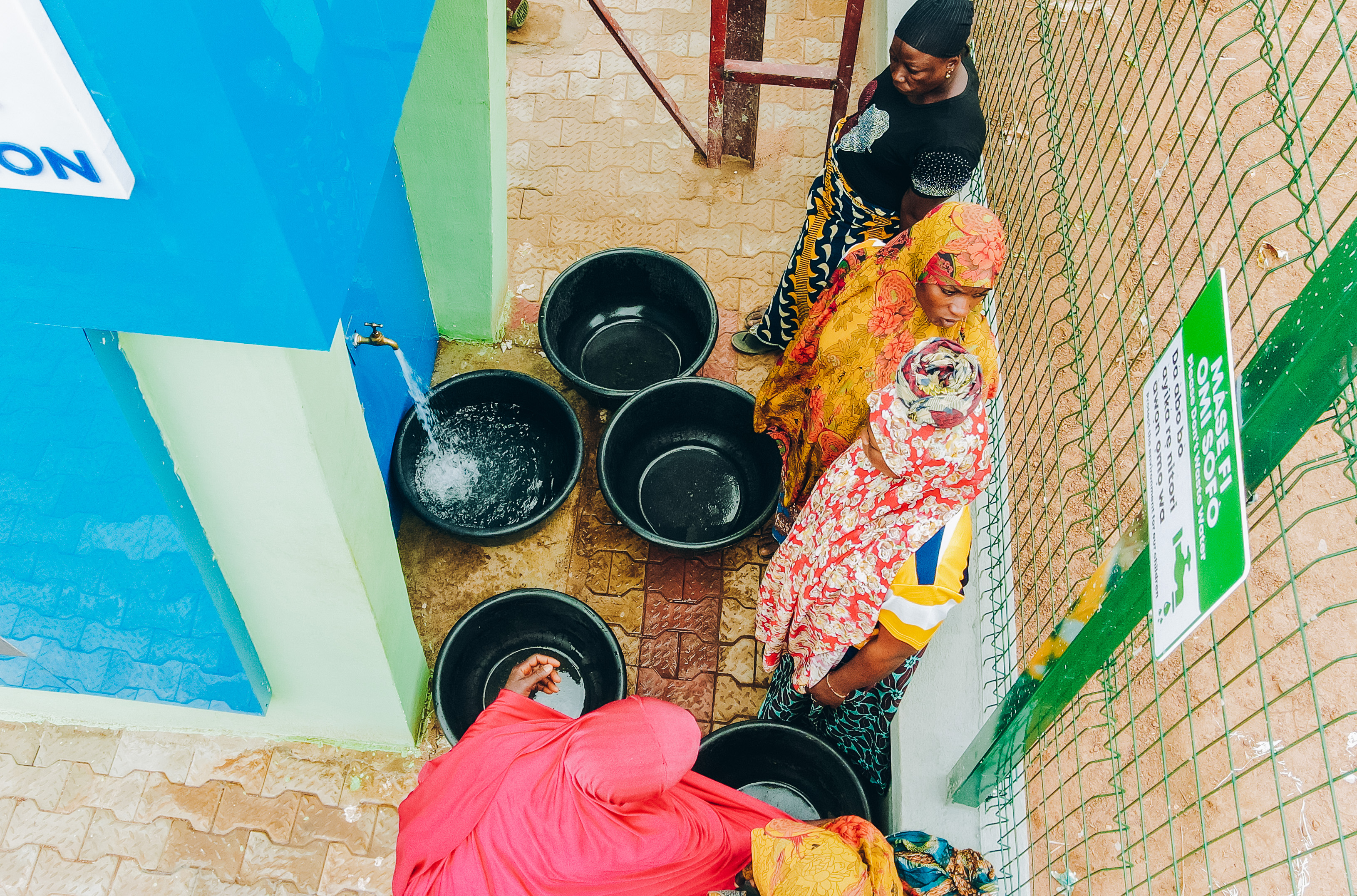 Reliable water service changes daily life. At a Fairaction water kiosk, women collect water from a system designed to keep working beyond construction, because lasting access, not one off installation, is what supports poverty reduction.
Key Takeaways
- Water deprivation is part of poverty, not only a cause of it. Households without safe water are poor in ways that income-only measures often miss.
- Access alone does not reduce poverty if systems do not last. The real benefit of a water project depends on how long it continues functioning.
- The sustainability gap is the sector’s biggest unresolved problem. Many systems are built, but too few are supported as lasting services.
- Fairaction takes a service-led position. The goal is not simply to install infrastructure, but to deliver reliable and affordable water over time.
- Professionalisation, affordability, and post-construction support matter. Sustainable water service requires paid roles, transparent monitoring, repair financing, and local accountability.
- Lasting poverty reduction depends on lasting service. Water investment should be judged by continuity of service, not by construction counts alone.
11 min read
Why water matters to SDG 1
Fairaction’s mission is to help achieve SDG Target 6.1: universal and equitable access to safe and affordable drinking water for all. SDG 1 sits immediately next to that work. Ending poverty and securing universal drinking water access are the same problem viewed from two angles. The regions where SDG 6.1 is hardest to deliver are also the regions where SDG 1 is most stuck. This is why the relationship between water and poverty matters to Fairaction as an organisation, and why it should matter to anyone funding water in places where both goals are now most in question. Fairaction’s operational work concentrates in Nigeria, which sits at the sharp end of both.
Where global poverty sits in 2025
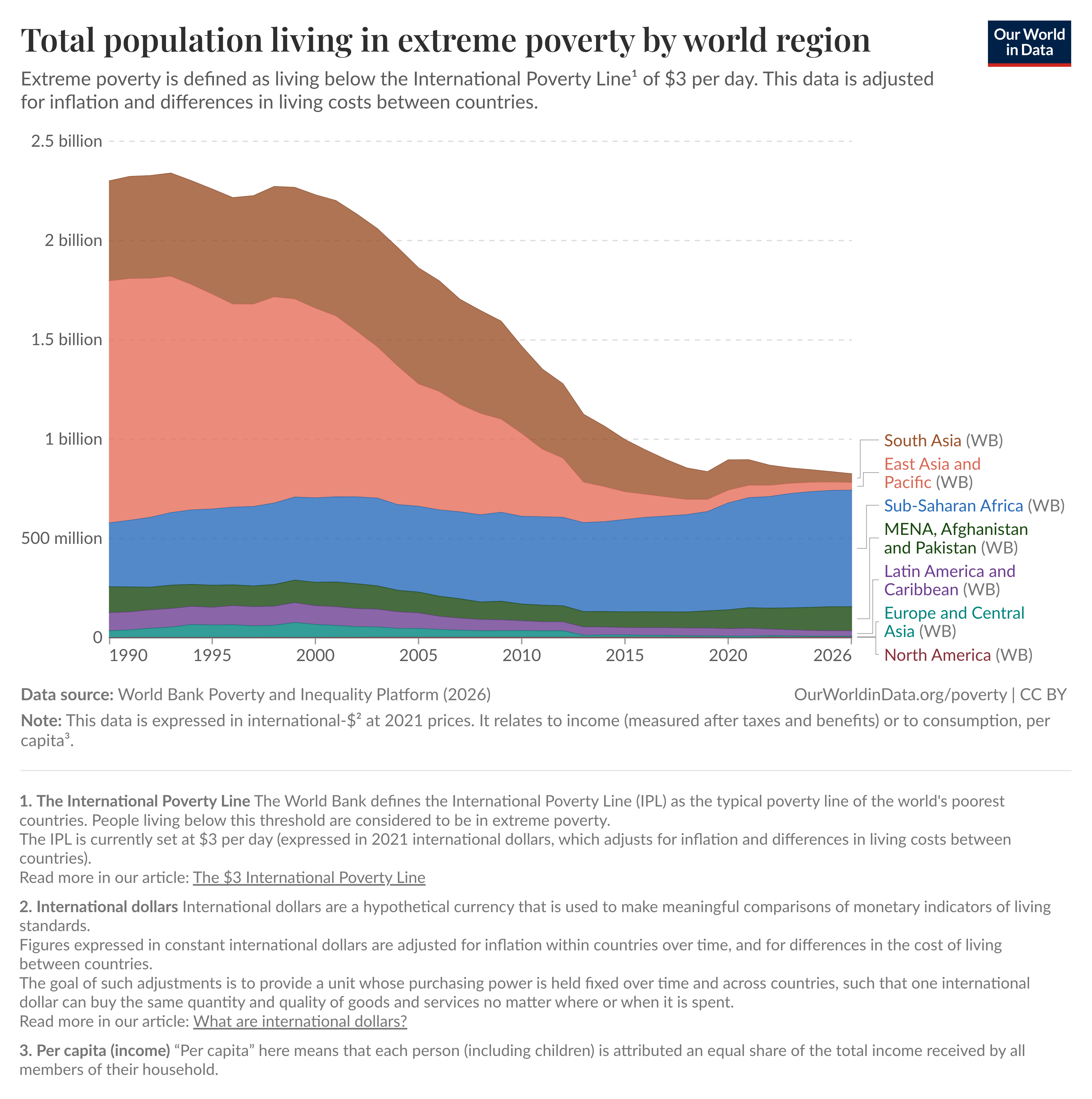
The latest figures are sobering. After the World Bank revised its international poverty line to US$3.00 per day in June 2025, the UN reported that around 808 million people were living in extreme poverty in 2025, about one in ten people globally.[1] World Bank nowcasts for the same year put the figure slightly higher, at around 839 million.[2] On current trajectories, close to 9 per cent of the world will still be living in extreme poverty in 2030. SDG 1 will not be met by the deadline.
The geography matters. Sub-Saharan Africa now holds the substantial majority of the world’s extreme poor, with an extreme poverty rate of around 46 per cent in 2024 according to the World Bank’s September 2025 update.[2] Within the region, the concentration is sharper still. Around half of all extreme poor in sub-Saharan Africa live in just four countries, and Nigeria is one of them.
The World Bank’s Nigeria Development Update, published in April 2026, reported that approximately 140 million Nigerians, around 63 per cent of the population, were living in poverty in 2025, with the rate having risen each year since 2023.[3] On current projections, the situation in Nigeria worsens before it improves. This is the context for asking what role water plays. It is not a peripheral question.
Water deprivation is part of poverty, not only a cause of it
It is important to be precise about the relationship. Water deprivation is not simply a cause of poverty in the income sense. It is part of how poverty itself is measured. The World Bank’s Multidimensional Poverty Measure counts drinking water, sanitation, and electricity alongside income and education as the three dimensions of poverty.[4] A household lacking improved drinking water meets one of the deprivation thresholds in the infrastructure dimension. SDG 1.4 echoes this directly by committing governments to equal access to basic services for poor and vulnerable people.
On the latest figures, around 17 per cent of people globally are multidimensionally poor, well above the 11 per cent counted as monetary-poor alone. The gap between those two numbers is the part of poverty that income-only measurement misses. A great deal of it is water.
The household-level mechanisms by which water deprivation shapes poverty are well established. The WHO and UNICEF Joint Monitoring Programme’s 2025 report found that around 2.1 billion people still lack safely managed drinking water and 3.4 billion lack safely managed sanitation.[5] Unsafe water imposes a measurable disease burden, with around one million annual diarrhoea deaths attributable to inadequate WASH and at least 1.4 million preventable deaths in total.[6]
Time poverty matters too. Women and girls collectively spend around 250 million hours every day fetching water, with women primarily responsible in more than seven in ten unserved rural households.[7] Households that gain on-premises piped water spend less time collecting it, and the time saved can be reallocated toward off-farm work and household income, particularly for women and in remote areas.[8] These findings are not contested. They are the empirical backbone of the case for water as poverty policy.
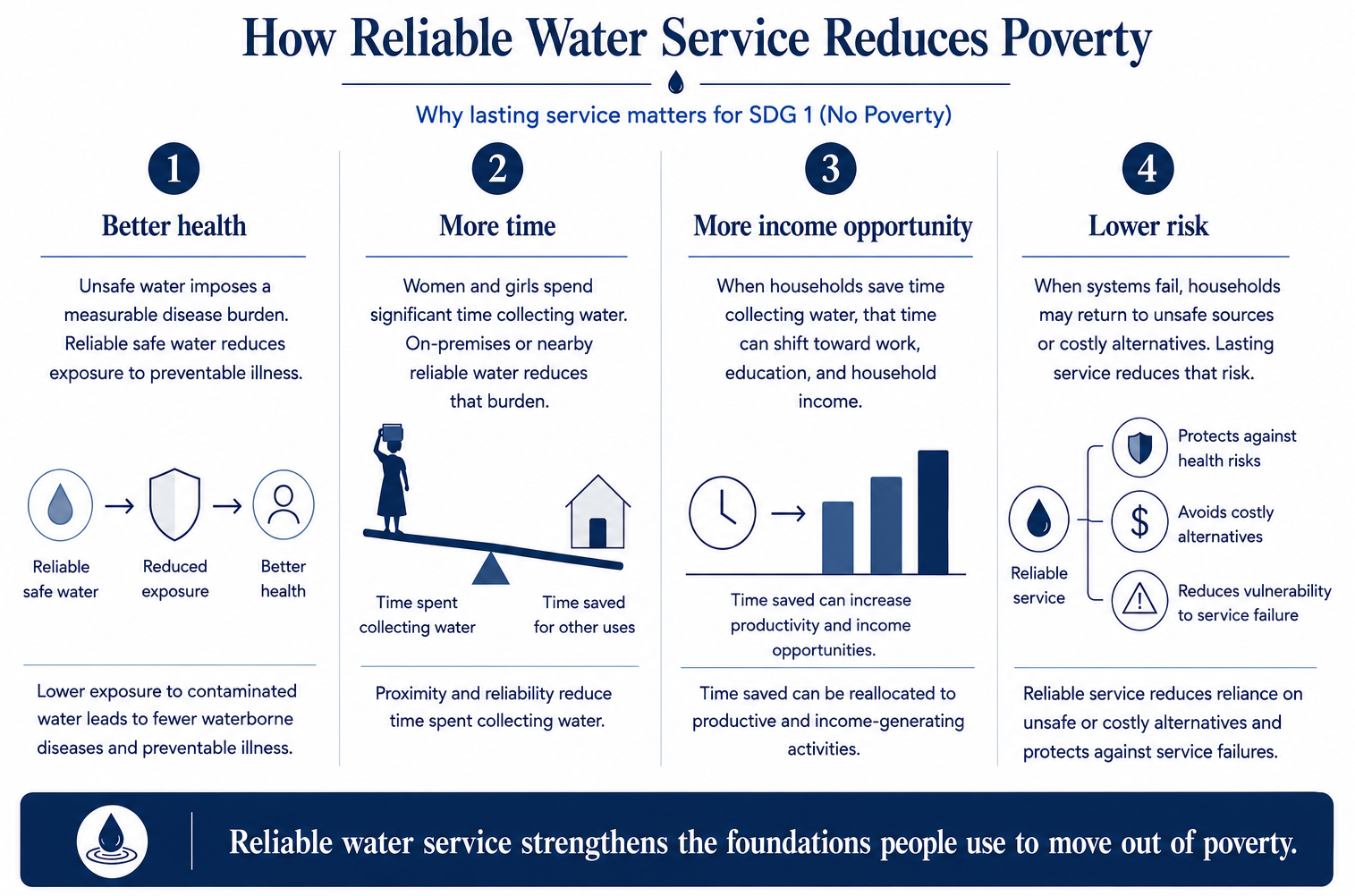 Reliable water service affects poverty through health, time, income, and risk.
--
Why water access progress still matters
The access agenda is real and substantial. The right response to the sustainability problem is not to dismiss the institutions and national programmes that have expanded water access. Much of this work has saved lives and lifted real numbers of households out of water deprivation.
India’s Jal Jeevan Mission has lifted rural household tap coverage from around 17 per cent in 2019 to over 81 per cent by late 2025, making it one of the largest and fastest rural water expansion efforts attempted at national scale.[9] WHO/UNICEF JMP figures also show that, globally, around 2.2 billion people gained access to safely managed drinking water between 2000 and 2024.[5] National programmes across sub-Saharan Africa are scaling, donor finance is rising, and political prioritisation of water is more visible than it has been at any point since the Millennium Development Goals.
This progress matters. The question is not whether access expansion is valuable. The question is what happens after the point of construction. If new access does not become continuing service, the poverty-reduction effect remains fragile.
Why water projects often fail after construction
The central challenge is not access. The central challenge is what happens to access after construction.
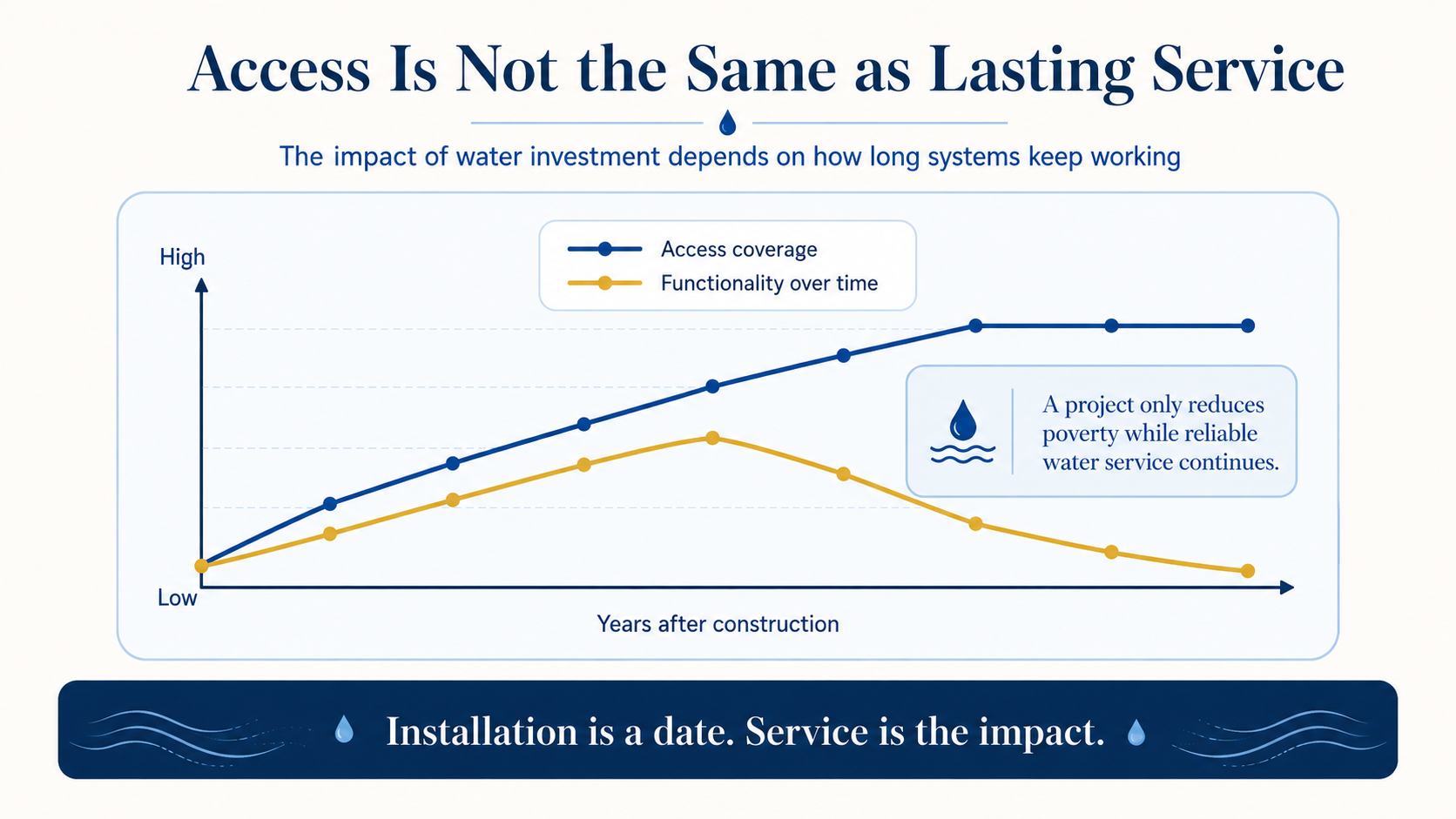 Installation is not impact. Water systems reduce poverty only while reliable service continues.
-
One of the most useful recent datasets on this point is the Murray et al. study published in Water Resources Research in 2024. It draws on monitoring data from 1,805 randomly selected rural water points across ten NGO programmes in nine countries in sub-Saharan Africa and South Asia.[10] Around 92 per cent of water points built within the previous year were functional. Among older points, averaging 3.5 years old, only 79 per cent were functional. The gap of thirteen percentage points in three and a half years is the standard story of rural water in one statistic.
The sub-findings are more revealing than the headline. Within the older-construction sample, tap stands from piped systems had 74 per cent lower odds of functioning than boreholes with handpumps.[10] That is counter-intuitive if higher service levels are assumed to be automatically better. It is not counter-intuitive once the institutional, technical, and financial requirements that piped systems demand are taken seriously. Higher water service levels offer benefits, but those benefits depend on the maintenance capacity that exists locally.
Work published in PNAS in 2021 reinforces the point. Under community-based management, still the dominant arrangement across rural sub-Saharan Africa, the typical waterpoint outage lasts a month or more before repair.[11] A month of downtime is not a minor inconvenience for a household whose nearest alternative is a contaminated surface source or a vendor charging several times the piped rate. Functionality figures can therefore understate welfare loss because they measure whether a system works in principle rather than whether it works when it is needed.
In Fairaction’s own researched communities in Nigeria, close to 50 per cent of water projects have failed at some point in their operational lifetime.[12] India’s experience is consistent with the same pattern at a different scale: the government’s 2024 functionality assessment under the Jal Jeevan Mission found that roughly a quarter of connected households were not yet receiving regular, safe, and adequate supply, prompting the programme’s extension to 2028 with a deliberate reframing from infrastructure creation to operational excellence.[13]
This is what the literature has come to call the sustainability gap. The investment builds. The service decays. The poverty-reduction effect that the access narrative promises is bounded by how long the system continues to work, and across much of rural sub-Saharan Africa it does not work for long enough.
Three sector debates Fairaction takes a position on
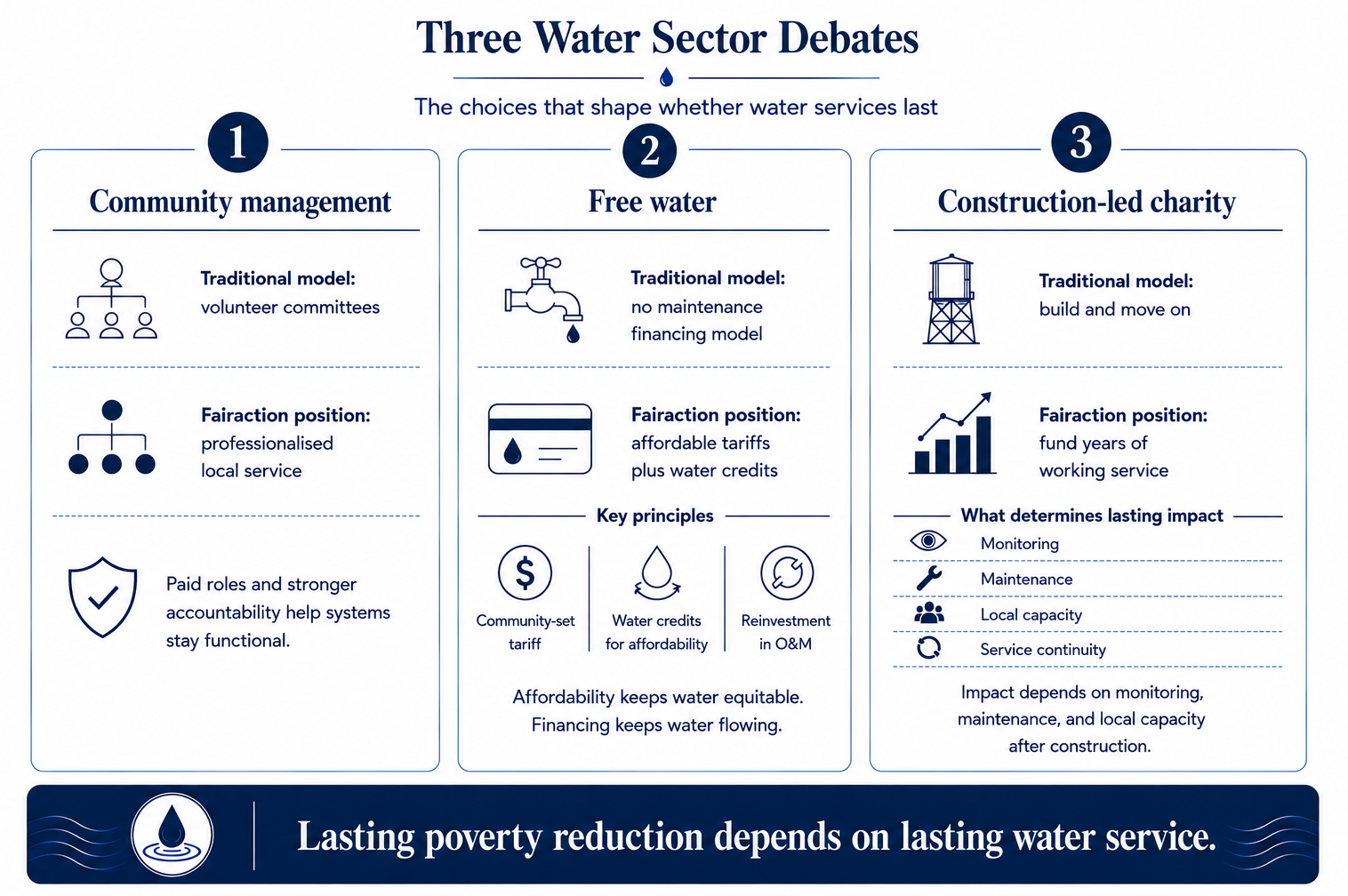
There are several recurring debates in the rural water sector where polite consensus is comfortable and the evidence is not. Fairaction’s view is that it is more useful to be explicit about the positions that make lasting service possible.
 --
--Community-based management versus professionalised service
The dominant model for rural water across sub-Saharan Africa for three decades has been community-based management, where a voluntary community committee takes responsibility for operation and maintenance. The model has been under scrutiny for years. IRC and others have argued that community-based management has to be professionalised, not because community involvement is wrong, but because voluntarism and informality have reached their limits.[14]
The free-rider problem is well documented: voluntary user fees consistently underfund the repair budgets they are meant to cover, and peer sanctions for non-payment can be socially divisive enough to erode the cohesion the model depends on.[15] Pilot work on CBM-lite, with a paid local water operator and tariff collection linked to formal financing, has produced visibly better functionality outcomes. Fairaction’s position is that professionalisation should no longer be treated as optional.
Free water versus affordable tariff-based water
The case for free water is morally clean and operationally dangerous. When water is provided for free with no maintenance financing model, the median outcome across rural sub-Saharan Africa is the abandoned tap stand. The alternative position, which Fairaction holds, is that the relevant question is affordability, not price.
A small, locally set per-litre tariff that finances operation and maintenance, combined with a water credit system for households unable to pay, produces continuing service. A donor-funded free system that runs out of repair money in year three does not. The first model recognises that lifecycle costs exist. The second wishes they did not.
Construction-led charity versus service-led charity
Most WASH fundraising still asks donors to build a borehole, a well, or a pump, with the implicit promise that the unit cost of installation is the unit cost of impact. Fairaction’s view is that this framing is one of the reasons the sector keeps producing the build-neglect-rebuild cycle.
Construction-led charity has a clean numerator and a hidden denominator: the cost is the build, but the impact depends on years of post-construction support that the build alone does not finance. A service-led approach inverts this. Funds are tied to years of working service delivered, which means budgets for mapping, monitoring, maintenance, and local technical capacity are non-optional from day one.
What Fairaction does differently
Fairaction’s framework runs in three phases, each one designed against a failure mode identified in the literature.
 Fairaction’s model treats sustainable water service as a system that must be designed, prepared, and operated over time.
--
Before construction
Before construction, the work is diagnostic. Communities are mapped using the open Target 6.1 Map, a Predictive Iterative Sustainability model assesses whether a proposed project can be operationally and financially viable in that specific community, and architectural designs are built against a defined infrastructure lifespan rather than against a fundraising calendar.[16]
During construction
During construction, the work is preparatory for service. Local technicians are trained in maintenance and repair, communities are educated on usage and operation, a local water committee is established, and a kiosk attendant is employed from within the community.
After construction
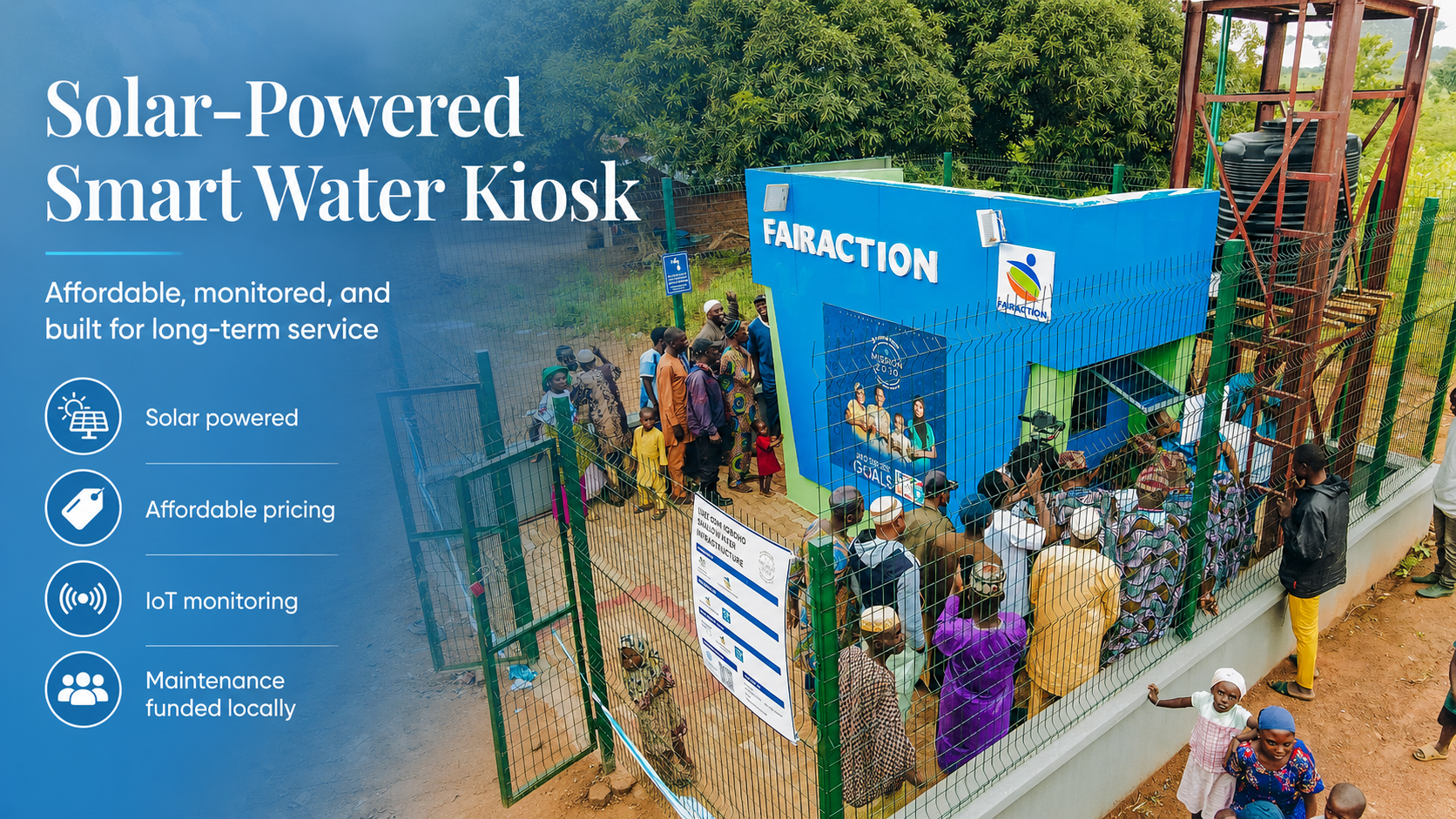
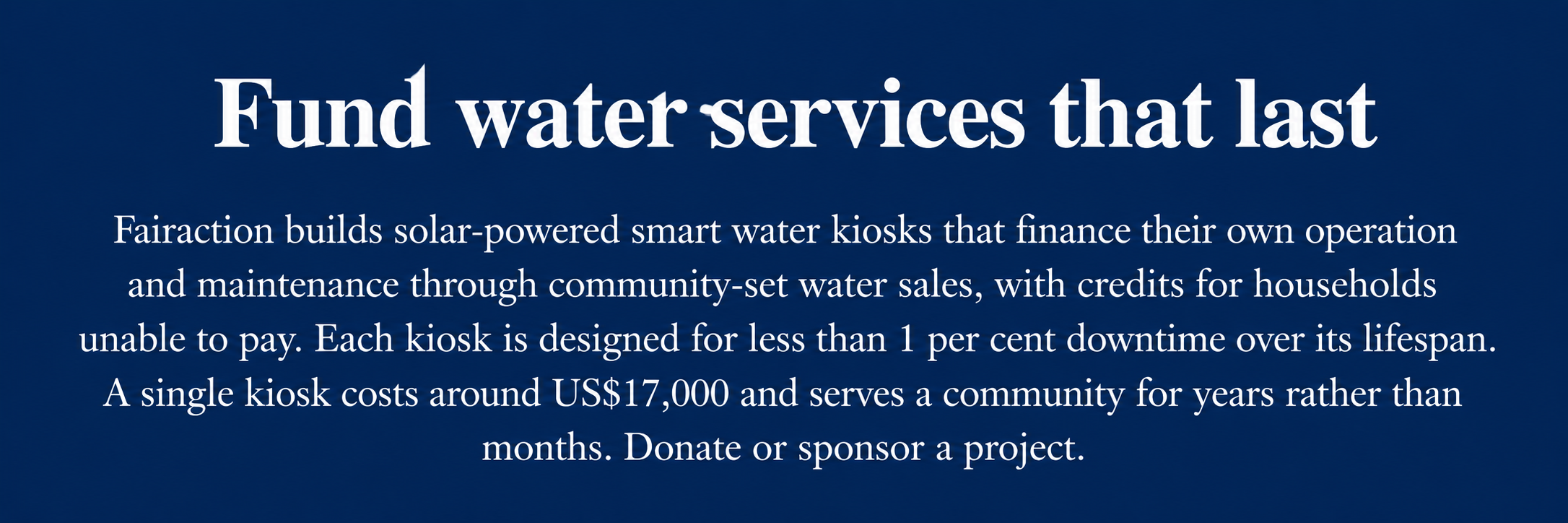
After construction, the work is operational. Solar-powered smart water kiosks combine flow sensors and automatic shutdown devices with affordable per-litre pricing set by the community itself, water credits for households unable to pay, and IoT monitoring that captures performance data continuously. Surplus from water sales is reinvested into operation and maintenance, with infrastructure designed for less than one per cent downtime over its lifespan.
The principle behind the details is that lasting poverty reduction in water depends less on the unit cost of installation and more on the design of the operating model that follows it. Scale should follow functionality, not precede it.
What this means for SDG 1
Three things follow from the analysis above.
Fund services, not assets. Budgets for water and sanitation should cover the operations, monitoring, and local repair capacity that determine whether the asset becomes a service.
Measure poverty in time, risk, and health, not only income. Multidimensional poverty frameworks are already mainstream at the World Bank and UNDP. National poverty measurement should follow.
Scale only what stays functional. New water finance should be tied to demonstrated service continuity and transparent performance data, not construction counts.
Ending poverty in all its forms by 2030 is no longer a realistic target. Ending it by 2040 or 2050 still is, provided the next decade of water investment is built around services that last, rather than installations that do not. That is the standard Fairaction holds itself to and the standard the sector should be held to.
--
References
[1] United Nations Statistics Division, The Sustainable Development Goals Report 2025: Goal 1. https://unstats.un.org/sdgs/report/2025/goal-01/
[2] World Bank, September 2025 global poverty update, Data Blog. https://blogs.worldbank.org/en/opendata/september-2025-global-poverty-update-from-the-world-bank--new-da
[3] World Bank, Nigeria Development Update: Nigeria’s Tomorrow Must Start Today (April 2026), as reported in Vanguard. https://www.vanguardngr.com/2026/04/nigerias-poverty-rate-climbs-to-63-despite-easing-inflation-world-bank/
[4] World Bank, Multidimensional Poverty Measure (October 2025 update). https://www.worldbank.org/en/topic/poverty/brief/multidimensional-poverty-measure
[5] WHO and UNICEF Joint Monitoring Programme, Progress on Household Drinking Water, Sanitation and Hygiene 2000-2024: Special Focus on Inequalities, August 2025. https://washdata.org/reports/jmp-2025-wash-households
[6] World Health Organization, Drinking-water fact sheet. https://www.who.int/news-room/fact-sheets/detail/drinking-water
[7] UNESCO, United Nations World Water Development Report 2026. https://www.unesco.org/en/world-water-report-2026
[8] Winter, J. C. et al., The role of piped water supplies in advancing health, economic development, and gender equality in rural communities, Social Science and Medicine. https://www.sciencedirect.com/science/article/abs/pii/S0277953620308182
[9] DD News / Ministry of Jal Shakti, Jal Jeevan Mission transforms rural India with tap water for over 15.72 crore households, October 2025. https://ddnews.gov.in/en/jal-jeevan-mission-transforms-rural-india-with-tap-water-for-over-15-72-crore-households/
[10] Murray, A. L. et al., Rural Water Point Functionality: Evidence From Nine Countries in Sub-Saharan Africa and South Asia, Rural Water Supply Network, 2024. https://rwsn.blog/2024/03/05/rural-water-point-functionality-evidence-from-nine-countries-in-sub-saharan-africa-and-south-asia/
[11] Hope, R. et al., Individual choices and universal rights for drinking water in rural Africa, PNAS, 2021. https://www.pnas.org/doi/pdf/10.1073/pnas.2105953118
[12] Fairaction International, How We Work. https://fairaction.ngo/about/how-we-work
[13] WaterAid, Professionalising rural and small-town water supply management, November 2024. https://washmatters.wateraid.org/publications/professionalising-rural-small-town-water-supply-management
[14] IRC, Professionalising community-based management for rural water services. https://www.ircwash.org/resources/professionalising-community-based-management-rural-water-services-building-blocks
[15] Foster, T. and Hope, R., Crime and punishment: the challenges of free-riding and peer sanctioning in the rural water sector - lessons from an innovation in Uganda, Geoforum 112, 2020. https://researchportal.port.ac.uk/en/publications/crime-and-punishment-the-challenges-of-free-riding-and-peer-sanct/
[16] Fairaction International, How We Work: Pre-construction, Construction, and Post-construction Phases. https://fairaction.ngo/about/how-we-work
Frequently asked questions
Because the official frameworks used to measure poverty count it that way. The World Bank's Multidimensional Poverty Measure includes drinking water, sanitation, and electricity in the infrastructure dimension of poverty, alongside monetary and education indicators. A household lacking safe water is poor in a way that no income measure will capture cleanly.
Because that is where the poverty is now concentrated. Sub-Saharan Africa holds the substantial majority of the world's extreme poor, and around half of all extreme poor in the region live in just four countries, of which Nigeria is one. The World Bank reported in April 2026 that around 140 million Nigerians were living in poverty in 2025.
The Murray et al. study published in Water Resources Research in 2024 is the strongest recent dataset. It found that around 92 per cent of newly built rural water points were functional versus around 79 per cent of older points averaging 3.5 years old, across 1,805 randomly selected sites in nine countries.
Because a free system without a maintenance financing model has a median outcome of breakdown and abandonment within a few years. A small per-litre tariff set by the local water committee finances operation and maintenance, and a water credit system covers households unable to pay. The relevant question is affordability, not price.
It refers to moving away from voluntary community management toward arrangements with paid roles, formal performance standards, transparent monitoring, and dedicated post-construction support. The evidence consistently shows higher functionality and faster repair times under professionalised models than under voluntary community-based management.
Join the Movement
If every child deserves a classroom, every classroom deserves clean water.
No child should walk miles for water before learning the alphabet.
No girl should drop out because her school cannot manage her dignity.
No community should be left behind by dry taps and broken toilets.
Together, we can change this.
💧 Join the Water and Education Alliance.
You can donate to Fairaction today to bring clean water, dignity, and hope to classrooms across Africa.
👉 Contact Us to Collaborate.