
Can This Community Run a Micro-Utility? A Transdisciplinary Test for Water Systems That Last
Written by Sam Adeoti, CEO at Fairaction
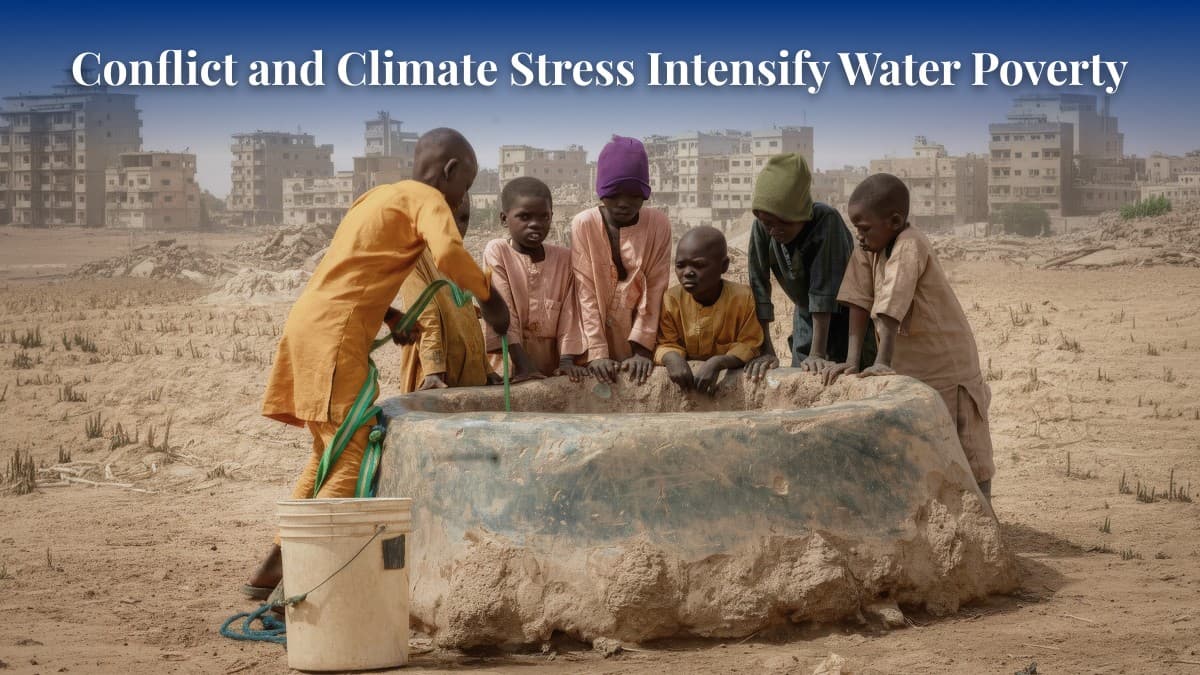
We are living through an era of compounding shocks: conflict, displacement, climate stress, and fiscal pressure. Humanitarian needs are rising while budgets are increasingly contested.
In 2024, global military expenditure reached $2.718 trillion [11]. At the same time, the UN’s Global Humanitarian Overview 2026 appealed for $33 billion to support 135 million people, with a prioritised $23 billion plan focused on the most life-threatening needs [12].
These pressures matter for SDG 6 because when conflict escalates, when climate stress intensifies, or when people are displaced, water challenges escalate quickly and communities feel it immediately. Demand concentrates in new locations. Existing systems become overstretched. Drought reduces availability. Flooding damages infrastructure and contaminates sources. Water quality becomes more fragile just when human need becomes more urgent [13][14].
But water poverty is not only a crisis-zone problem.
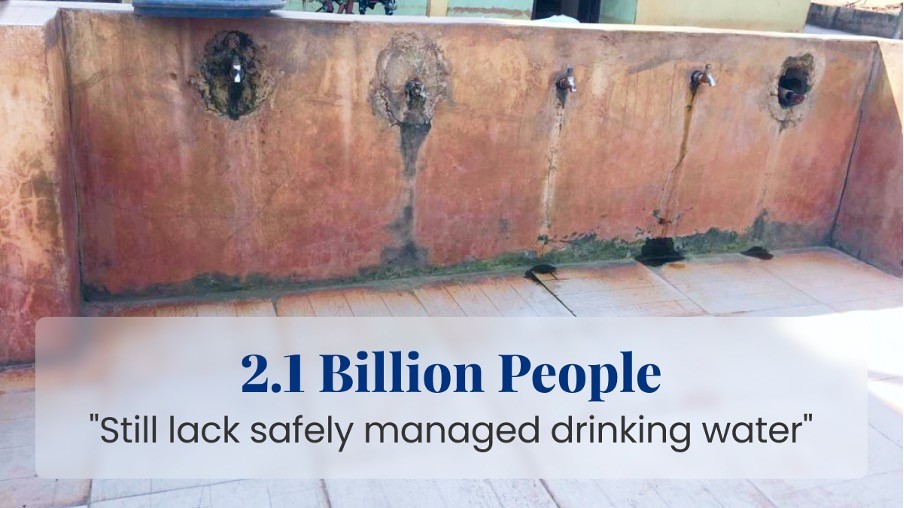
Even without accounting for displacement or climate-related disruption, the baseline remains severe. In 2024, 2.1 billion people still lacked safely managed drinking water globally [1]. And in many places, the challenge is not only lack of infrastructure. It is the failure of infrastructure to remain functional, trusted, and governable over time.
That is the point that continues to shape my work.
Too much of the sector still asks the wrong first question. It asks whether a community needs a water project. That question matters, but it is not enough. Need can justify action. It cannot guarantee sustainability.
The harder and more useful question is this:
Can this community run a micro-utility?
That question changes everything because it reframes water access from an installation problem into a service-systems problem. It asks whether the community-level infrastructure can function not simply as a physical asset, but as a reliable, managed, financially coherent, socially accepted, and institutionally supported service.
And that is precisely why sustainable water access demands transdisciplinary innovation.
Why the micro-utility question matters
A project is an asset. A micro-utility is a service organisation, even when it is small.
Once you think in those terms, the logic changes. You can no longer stop at drilling, construction, or hardware quality. You have to examine whether the system can actually operate in the real world: who takes responsibility, how performance is tracked, how maintenance is funded, how trust is sustained, how user behaviour affects viability, and how the service responds when shocks occur.
This is also where many conventional interventions become structurally weak. They are often designed as technical projects with social assumptions attached afterwards. But sustainability does not emerge from technical adequacy alone. It emerges from the interaction of technical, financial, social, institutional, and behavioural conditions over time.
That is why I find the term micro-utility so useful. It forces seriousness. It tells us that a borehole, kiosk, or managed waterpoint should be understood not as a donation endpoint, but as a small-scale utility that must survive daily pressure, imperfect incentives, and changing local realities.
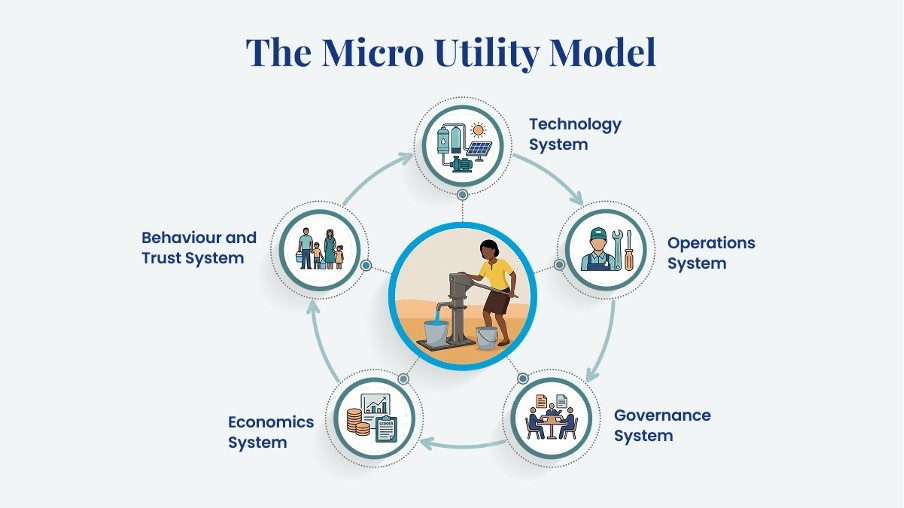
The micro-utility model: five coupled systems you must design together
When you ask “can this community run a micro-utility?”, you are asking whether five coupled systems can work together over time:
Technology system: Source reliability, treatment, energy, durability, maintainability.
Operations system: Who operates daily, how faults are detected, response time, spare parts pathways.
Governance system: Decision rights, accountability, conflict resolution, rules, enforcement.
Economics system: Life-cycle financing, pricing logic, affordability protection, revenue stability.
Behaviour and trust system: Adoption drivers, perceived quality, proximity, convenience, and how confidence is restored after disruption.
When these are designed separately, failure happens at the interfaces. A technical fault becomes a governance dispute. A pricing decision becomes an equity failure. A trust shock becomes underutilisation. Underutilisation becomes financial fragility. Financial fragility becomes downtime, and downtime reinforces trust collapse.
That cascade is not “community failure.” It is systems design failure.
What the evidence shows when we measure real services, not just installations
One of the reasons water programmes can appear more successful on paper than in practice is that they are often measured at the point of delivery, not through the full life of the service.
A more useful question is not “Was infrastructure built?” but “What happens next?”
Three lessons stand out.
1) Failure is often a missed recovery window, not a sudden collapse
Infrastructure rarely moves from “working” to “abandoned” in one dramatic step. More often, it declines through stages. What determines the outcome is whether the system can respond while the problem is still small.
That is the micro-utility difference. A service with clear authority, repair pathways, and financing can recover. A service without them drifts toward irreversible failure [2].
2) Adoption is not secondary. It is one of the engines of sustainability
A system can be technically sound and still underperform if households do not use it consistently.
Research on underutilisation in a water-poor Nigerian community found that even when treated water was available through smart infrastructure, adoption remained low. Only 16.3% of households used it, and usage over 168 days reached just 1.52% of designed capacity. Each additional minute of walking sharply reduced the odds of adoption
That is a decisive insight. Proximity, convenience, trust, and lived behaviour are not peripheral to sustainability. They are causal.
3) Reliability and sustainability are not the same thing
A system can deliver water consistently and still become economically unstable.
Longitudinal evidence from a smart water kiosk over 1,095 days showed high reliability and eventual sustainability with external support, but it also documented how self-sustainability could collapse when aid overlap disrupted the revenue logic needed to fund ongoing operations [6].
This is why sustainability cannot be reduced to technical performance alone. It is an emergent property of the wider service system, shaped by governance, economics, user behaviour, and coordination, alongside engineering [6].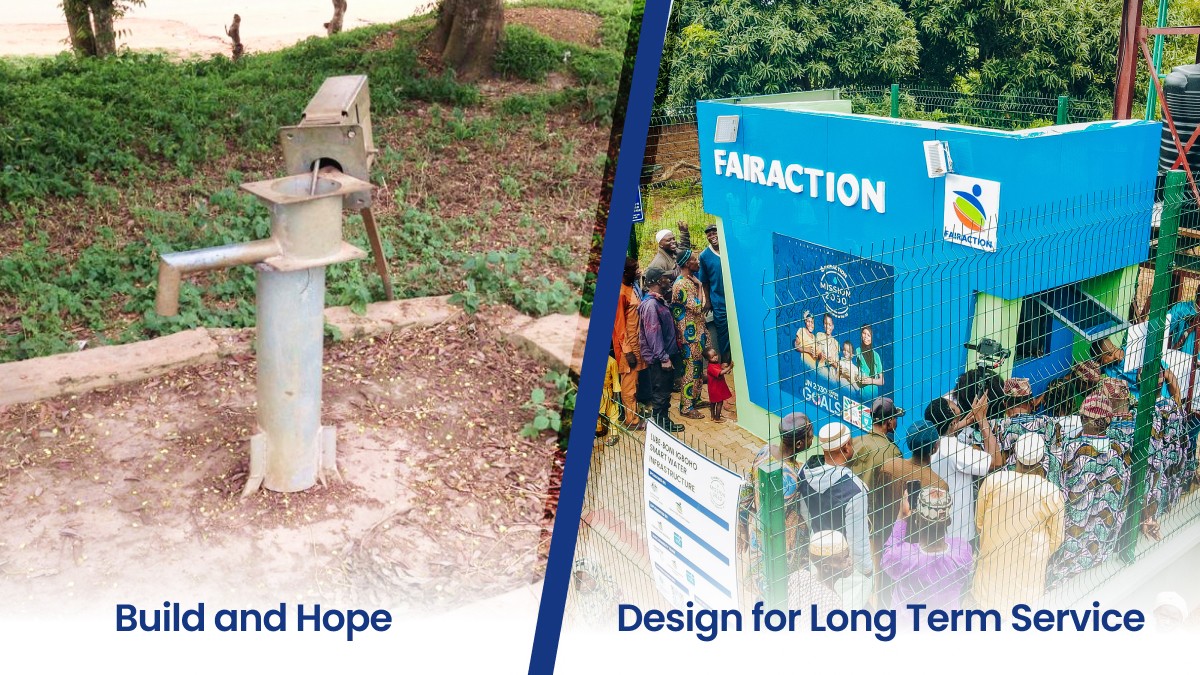
Moving Beyond Traditional Practice to Evidence-Based Sustainability Planning
Most traditional water delivery models evaluate sustainability only after implementation, when failure has already become expensive, trust has already been weakened, and redesign becomes far more difficult.
Fairaction’s approach shifts sustainability upstream in the project lifecycle, starting with comprehensive pre-construction assessment rather than relying solely on post-construction evaluation.
This assessment combines mapping, context analysis, viability screening, and structured sustainability diagnostics to understand the conditions that will shape long-term performance before infrastructure design is finalised. Predictive tools such as the Predictive Iterative Sustainability Model (PISM) strengthen this process by assessing whether a location and proposed service model are likely to remain viable over time [7][8].
The objective is not simply to identify where water is needed. It is to determine what kind of system can realistically survive there.
Once that foundation is established, the approach extends across the full lifecycle of the service.
How Fairaction works across the lifecycle
This is where Fairaction’s identity matters.
Fairaction is not only documenting water poverty. It is building and refining a sustainability architecture for ending it. That architecture works across the full lifecycle.
Pre-construction: We map communities, diagnose constraints, assess viability, and identify the factors most likely to shape sustainability in context. This is where need is translated into a serious design question [8].
Construction: We do not think of this phase as “building hardware and leaving.” It includes the service logic, decision pathways, and operational structures required for the infrastructure to function as a real service [8].
Post-construction: We monitor, track, and learn. We use data not only to report outcomes, but to detect underperformance early, improve reliability, and strengthen future deployments. The Target 6.1 Map plays an important role here by creating a transparent record of project-level sustainability metrics and lifecycle performance [8][9].
That is why I describe Fairaction’s work as research-led but infrastructure-facing. The research is not separate from implementation. It is part of the implementation model itself. Watch Fairaction’s CEO explain how we work: https://youtu.be/s5Xx8iFeC2E
Why this matters for ESG, CSR, and grantmakers
This conversation is not only relevant to researchers.
For ESG and CSR leaders, sustainable water systems are one of the clearest ways to connect measurable social value with governance-grade accountability. Water directly affects health, livelihoods, equity, resilience, and dignity. When performance is transparently monitored, it also becomes far easier to verify impact claims and reduce the risk of symbolic rather than substantive investment.
For philanthropists and grantmakers, the implication is equally important. In a constrained funding environment, repeated failure is not neutral. It is expensive, corrosive, and avoidable. Funding durable service systems rather than one-off installations is one of the strongest ways to convert limited capital into long-term poverty reduction and community prosperity.
What to fund if you want “access” that lasts
If your organisation is serious about durable SDG 6 outcomes, the highest-value funding is often not the most visible part of the project.
It is the part that protects sustainability.
That means funding:
comprehensive pre-construction intelligence, including mapping, diagnosis, viability screening, and sustainability assessment
service integrity, including governance, maintenance readiness, operator incentives, and affordability design
monitoring and verification, so problems are detected early and performance is measurable over time
This is where sustainable water stops being a construction output and becomes infrastructure that communities can actually rely on.
Stay Connected
Subscribe to read more on the science of sustainable infrastructure: evidence-based insights, field metrics, and practical lessons on building systems that last.
Follow Fairaction International for field-related reports on sustainable water solutions: linkedin.com/company/fairactioninternational/
For partnership enquiries: Partnership@fairaction.ngo
References
[1]. UNICEF DATA. Drinking water: safely managed drinking water, global estimates through 2024.
[2]. Adeoti, O. S., Kandasamy, J., & Vigneswaran, S. (2024b). Water infrastructure sustainability challenge in Nigeria: A detailed examination of infrastructure failures and potential solutions. Water Supply, 24(6), 2066–2076. https://doi.org/10.2166/ws.2024.127
[3]. Lang, D. J., et al. (2012). Transdisciplinary research in sustainability science: practice, principles, and challenges. Sustainability Science, 7, 25–43. https://doi.org/10.1007/s11625-011-0149-x
[4]. Adeoti, O. S., Kandasamy, J., & Vigneswaran, S. (2023). Water infrastructure sustainability in Nigeria: a systematic review of challenges and sustainable solutions. Water Policy, 25(11), 1094–1111. https://doi.org/10.2166/wp.2023.173
[5]. Adeoti, O. S., et al. (2025). Diagnosing water infrastructure underutilization: a planning framework for behavioral risk, smart monitoring, and SDG 6.1 alignment. Water Supply. https://doi.org/10.2166/ws.2025.088
[6]. Adeoti, O. S., Haremi, R., Kandasamy, J., & Vigneswaran, S. (2025). Evaluating the effectiveness of smart water management systems in enhancing the resilience and sustainability of water infrastructure in Nigeria. AQUA, 74(2), 253–266. https://doi.org/10.2166/aqua.2025.291
[7]. Adeoti, O. S., Kandasamy, J., & Vigneswaran, S. (2024). Sustainability framework for water infrastructure development in Nigeria: a modelling approach. Water Supply, 24(8), 2933–2945. https://doi.org/10.2166/ws.2024.193
[8]. Fairaction International. How we work. https://fairaction.ngo/about/how-we-work
[9]. Fairaction International. Target 6.1 Map. https://fairaction.ngo/target-6-1-map
[10]. Fairaction International (YouTube). How we work (video). https://www.youtube.com/watch?v=s5Xx8iFeC2E
[11]. SIPRI. (2025). Trends in World Military Expenditure, 2024. https://www.sipri.org/sites/default/files/2025-04/2504_fs_milex_2024.pdf
[12]. UN OCHA. (2025). Global Humanitarian Overview 2026 appeal. https://www.unocha.org/news/life-life-un-launches-us33-billion-aid-appeal-urgent-call-global-solidarity
[13]. IPCC. (2022). AR6 WGII: Water (Chapter 4). https://www.ipcc.ch/report/ar6/wg2/chapter/chapter-4/
[14]. UNHCR. (2025). Mid-Year Trends 2025. https://www.unhcr.org/media/mid-year-trends-2025
[15]. UN-Water. (2016). Water and sanitation interlinkages across the 2030 Agenda for Sustainable Development. https://www.unwater.org/sites/default/files/app/uploads/2016/08/Water-and-Sanitation-Interlinkages.pdf
Join the Movement
If every child deserves a classroom, every classroom deserves clean water.
No child should walk miles for water before learning the alphabet.
No girl should drop out because her school cannot manage her dignity.
No community should be left behind by dry taps and broken toilets.
Together, we can change this.
💧 Join the Water and Education Alliance.
You can donate to Fairaction today to bring clean water, dignity, and hope to classrooms across Africa.
👉 Contact Us to Collaborate.